ITR due date, transfer pricing cases: 30 Nov 2026 7 days left

TDS / TCS deposit for last month: 7 Dec 2026 14 days left

GSTR-1 (monthly filers): 11 Dec 2026 18 days left

Advance tax, 3rd instalment (75%): 15 Dec 2026 22 days left

+91 87500 70081wecare@taxcaller.comAsk TaxCaller

Md Salim, TaxCaller expert, in the TaxCaller office

Public Limited Company in India: Meaning and Registration

A public limited company can have any number of shareholders and offer shares to the public. Our tax experts handle its SPICe+ registration, INC-20A and first-year compliance online.

Content updated 21 Nov 2026

★ Special offer🎁 Free expert consultation

Register your Public Limited Company

23 online
Starting from · ₹6,999 Public Limited Company Registration Basic plan
STARTING FROM₹6,999
FEE TOLD UPFRONTFree first call
New company?File INC-20A within 180 days of incorporation
IN +91
🔒 No spam · Privacy
Since 2018Trusted Experience
980+Experts Connected
220+Cities Served
1164+Agents Available
12,650+Founders Trusted
S

Srishti Magoo

★★★★★

Excellent experience with TaxCaller for filing my & my family members ITR returns. The entire process was smooth, quick and hassle-free. They are professional, knowledgeable and guided me through every step with patience.

O

obeid sait

★★★★★

The team has handled my taxes for the past three years, and it's been a wonderful, hassle-free experience. Thank you for your consistently quick and efficient service.

P

Pushkar

★★★★★

They are among the best in their field. Their work culture is highly professional, and their client service is smooth and reliable. They can confidently be relied on to get the job done.

P

Prasad Sheth

★★★★★

Excellent experience with TaxCaller! The ITR filing process was smooth, quick, and completely hassle-free. The CA was knowledgeable, responsive, and explained everything clearly.

A

Apoorv Bansal

★★★★★

Excellent service for ITR filing. The team was highly professional, responsive, and guided me through the entire process smoothly. My return was filed accurately and on time.

A

Abhishek Kumar

★★★★★

I was searching for a good CA firm in Ghaziabad and found TaxCaller. The experience was excellent from start to finish. The team is responsive, transparent, and genuinely helpful.

U

uma pandey

★★★★★

Great service! TaxCaller India made the entire ITR filing process quick, smooth, and hassle-free. They answered all my queries patiently and ensured maximum accuracy.

T

tanu mittal

★★★★★

Excellent job! We've been connected for many years, and your success truly makes me happy. You are an incredibly intelligent person. Keep shining, keep growing.

B

Bhanu Pratap Maurya

★★★★★

I am filing my ITR since past 3 years with Abhinav and Firm is known as TaxCaller and they are professional interms of ITR rules. They will explain and tell you all the information.

A

ashish Sharma

★★★★★

I am providing my honest reviews: No.1 service ...

A

AARYAN GROUP

★★★★★

Honestly, finding a good CA firm in Ghaziabad was confusing, but TaxCaller India made it simple. I contacted them for GST work and the experience was smooth.

N

News Speaks

★★★★★

If you're looking for a reliable CA firm in Ghaziabad, TaxCaller India is a great choice. They provide complete taxation and compliance solutions including GST.

A

Anshul Chaprana

★★★★★

Got my GST registration done through TaxCaller CA firm. Process was quite smooth, they guided properly on documents and didn't waste time. Overall good experience.

How we work

Online · Call · WhatsApp

Quick answer

A public limited company is a company that can have any number of shareholders, offer shares to the public and list on a stock exchange. In India, you register one online with the MCA through SPICe+, with seven members and three directors. It takes about 10 to 20 working days. TaxCaller charges from ₹6,999 + GST, plus government fees.

Reviewed by Abhinay Rai · Updated 21 Nov 2026

Pick a plan that fits

Basic

Promoters who need the public company incorporated

₹6,999 + GST

+ Govt. fee and stamp duty at actual

Pay now (49%)₹3,430+ GST After the CIN₹3,569+ GST
Zubair, TaxCaller expertHandled by a TaxCaller Expert Company Registration Expert
Book Now

Fee confirmed in writing before you pay

What you'll get

  • Free first call on structure, capital and state
  • Name search and SPICe+ Part A filing
  • MoA and AoA drafted for a public company
  • SPICe+ Part B with DIN for 3 directors
  • e-MoA, e-AoA, AGILE-PRO-S and INC-9 prepared
  • Certificate of Incorporation with CIN, PAN and TAN
  • Checklist for the first 180 days

Most Popular

Standard

Founders who want the first 180 days handled

₹9,999 + GST

+ Govt. fee and stamp duty at actual

Pay now (49%)₹4,900+ GST After the CIN₹5,099+ GST
Abhinay Rai, TaxCaller expertHandled by a TaxCaller Expert Company Registration Expert
Book Now

Fee confirmed in writing before you pay

What you'll get

  • Everything in Basic
  • INC-20A commencement of business filing
  • First board meeting notice and minutes
  • First auditor appointment papers
  • ISIN and RTA coordination for demat shares
  • Statutory registers set up

Premium

Companies that want a full first-year setup

₹13,999 + GST

+ Govt. fee and stamp duty at actual

Pay now (49%)₹6,860+ GST After the CIN₹7,139+ GST
Shadab, TaxCaller expertHandled by a TaxCaller Expert Company Registration Expert
Book Now

Fee confirmed in writing before you pay

What you'll get

  • Everything in Standard
  • GST registration
  • Udyam (MSME) registration
  • First-year ROC filings: AOC-4, MGT-7 and related forms
  • Compliance calendar for board meetings and AGM

Government fees and taxes are extra where applicable. Our expert confirms the final amount on the first call. No hidden charges.

About Public Limited Company Registration

A public limited company is a company under the Companies Act, 2013 that can have any number of shareholders and can offer its shares to the public. It can also list on a stock exchange if it chooses. Public limited company registration is the process of forming one online with the Ministry of Corporate Affairs (MCA) through the SPICe+ form.

A public company needs at least seven members and three directors, and its name ends with "Limited". In return for wider funding options, it follows stricter rules on boards, audits, meetings and disclosures than a private company.

This page explains who should form one, what it costs, how we file it, what happens after incorporation and what changed in 2026. Our expert handles the full filing online, so you never need to visit the Registrar of Companies.

Complete guide

Choose a topic to open it. Every answer gives the rule or section it comes from.

01 Topic 1 of 23

What Is a Public Limited Company?

Section 2(71) of the Companies Act, 2013 defines a public company as a company that is not a private company. In simple terms, its articles do not cap members at 200. They also do not restrict share transfers the way Section 2(68) requires for a private company.

A public limited company is a separate legal person under Section 9. It can own property, sign contracts, borrow and sue in its own name. Members are liable only for any amount unpaid on their shares. Section 58(2) makes the shares of a public company freely transferable, subject to any contract between members.

Main types of public companies

TypeWhat it means
Unlisted public companyIts shares are not listed on any stock exchange. Most new public companies start here.
Listed public companyIts securities are listed on a recognised stock exchange, as Section 2(52) defines. SEBI rules apply on top of the Companies Act.
Deemed public companyA private company that is a subsidiary of a public company. The proviso to Section 2(71) treats it as public.
Company where members pledge a fixed amount (Section 2(21))Members promise to contribute a fixed amount if the company winds up. Trade bodies and clubs often use it.
Government companyThe Central or State Government holds at least 51% of paid-up capital, under Section 2(45).
Nidhi companyA mutual benefit company under Section 406. It is set up as a public company and follows the Nidhi Rules, 2014.

This page covers the common case. That is a public company limited by shares, formed by Indian promoters, that starts unlisted. The other types use the same SPICe+ route, with extra approvals where the law asks for them.

Public company versus listed company

People often mix up the two. Every listed company is a public company, but most public companies are not listed. Registration makes you a public company. Listing is a later, separate step that needs a public issue and stock exchange approval.

Next: Who Owns and Runs It: Key Features in Law →

02 Topic 2 of 23

Who Owns and Runs It: Key Features in Law

The shareholders own a public limited company, and the board of directors runs it. The company itself is a separate legal person, so it owns its assets and owes its own debts.

Who is the owner?

The members, meaning the people or bodies holding its shares, own the company in proportion to their holding. Promoters who form the company usually hold a large block at the start. As the company issues more shares, ownership spreads out. In a listed company, thousands of public shareholders may own small stakes. No single person owns the company's assets directly.

Who manages it?

Members elect directors at general meetings. The board takes most business decisions and appoints the managing director and key managerial staff. Some decisions stay with the members, such as changing the articles, borrowing above the Section 180 limits or approving a merger. Those need a special resolution.

Main features at a glance

FeatureWhat it meansLaw
Separate legal entityThe company holds property, signs contracts and sues in its own nameSection 9
Perpetual successionThe company continues when members die, sell shares or directors changeSection 9
Limited liabilityA member risks only the unpaid amount on their sharesSection 2(22)
Free transfer of sharesShares can be sold without board approval, subject to any contract between membersSection 58(2)
Common sealOptional since the Companies (Amendment) Act, 2015; documents can be signed by two directors, or a director and the company secretarySections 9, 22(2) and 46(1), as amended in 2015
Quorum for general meetings5 members present if members are up to 1,000; 15 if up to 5,000; 30 above thatSection 103(1)(a)
Directors retiring by rotationAt least two-thirds of the directors are rotational, and one-third of them retire at each AGMSection 152(6)
Company identity numberA 21-character CIN issued with the certificate of incorporationSection 7(3)

Independent directors are not counted for rotation. A retiring director can stand again for appointment at the same AGM.

Zubair

Zubair Company Registration Expert

Have a question on this topic? Ask Zubair on a free call.

Ask an expert

← Previous Next: Is a Public Company the Right Choice for You? →

03 Topic 3 of 23

Is a Public Company the Right Choice for You?

Most founders do not need a public company on day one. A Private Limited Company is quicker to set up and cheaper to run. It still lets you raise equity from up to 200 members. For non-profit work, a Section 8 company fits better. Professionals with no investor plans can keep paperwork light with an LLP.

A public company makes sense when you truly need more than 200 shareholders, want to invite the public to invest, or plan to list. The table shows the differences that matter at the start.

PointPublic LimitedPrivate Limited
Minimum members72
Maximum membersNo limit200, not counting present and past employee members
Minimum directors32
Name ends withLimitedPrivate Limited
Share transferFreely transferableRestricted by the articles
Invite the public to subscribeAllowed, through a prospectusNot allowed
Managerial pay limit11% of net profit, Section 197Section 197 does not apply
Board meetingsAt least 4 a year4 a year, or 2 if a small company
Small company reliefNot availableAvailable within the limits
Demat sharesMandatory since 2 October 2018Mandatory for non-small private companies under Rule 9B

For a full comparison of every structure, see our company registration guide. Our expert can also tell you on a free call whether the extra compliance is worth it for your plans.

← Previous Next: Indian Public Company vs a UK plc: Ltd, Limited and PLC →

04 Topic 4 of 23

Indian Public Company vs a UK plc: Ltd, Limited and PLC

Many search results describe the UK "plc", not the Indian public company. The two are similar in idea, but the rules differ. The suffixes also mean different things in each country.

PointIndiaUnited Kingdom
LawCompanies Act, 2013Companies Act 2006
Name ending"Limited" for a public company; "Private Limited" for a private one"plc" or "public limited company" for a public company; "Ltd" for a private one
Minimum members71
Minimum directors3, one of them resident in India2 (section 154)
Minimum share capitalNone since 2015£50,000 allotted (section 763), at least one-quarter paid up (section 586)
Company secretaryWhole-time secretary once paid-up capital reaches set limitsRequired for every plc (section 271)
RegistryRegistrar of Companies under the MCACompanies House

So "Ltd" in a UK name signals a private company, while "Limited" at the end of an Indian name signals a public one. An Indian private company must always carry "Private Limited". If a guide quotes a £50,000 capital rule or two directors, it is describing UK law, not Indian law.

← Previous Next: When Public Limited Company Registration Is Needed →

05 Topic 5 of 23

When Public Limited Company Registration Is Needed

No law forces an ordinary business to become a public company. But some plans and sectors leave no other option.

  • More than 200 shareholders: a private company cannot cross 200 members under Section 2(68). A large family group or a venture with many small owners needs a public company.
  • Inviting the public to invest: only a public company can offer securities to the public through a prospectus, under Section 23(1).
  • Stock exchange listing: a company must be public before an IPO on the main board or an SME platform.
  • Deposits from the public: Section 76 lets only an eligible public company accept deposits from non-members. It needs net worth of ₹100 crore or more, or turnover of ₹500 crore or more.
  • Nidhi companies: a mutual benefit fund must be formed as a public company.
  • Subsidiary of a public company: it is treated as public even if registered as private.
  • Some regulated sectors and tenders: certain regulators, lenders and large buyers prefer or require a public company. Check the rule for your sector before you choose.

Who usually forms one

  • Promoters planning an SME or main board IPO in the next few years.
  • Growing family businesses with many relatives as shareholders.
  • Infrastructure, finance and manufacturing projects that need wide-based capital.
  • Industry associations and clubs whose members pledge a fixed sum instead of buying shares.
  • Groups where a public company will be the holding company of several businesses.

If none of these fit you yet, start as a private company and convert later. We explain that route in a section below.

Abhinay Rai

Abhinay Rai Company Registration Expert

Have a question on this topic? Ask Abhinay on a free call.

Ask an expert

← Previous Next: Minimum Requirements: 7 Members, 3 Directors and an Office →

06 Topic 6 of 23

Minimum Requirements: 7 Members, 3 Directors and an Office

RequirementRuleLaw
Members (subscribers)At least 7. No upper limit.Section 3(1)(a)
DirectorsAt least 3, up to 15. More than 15 with a special resolution.Section 149(1)
Resident directorAt least one director who stayed in India for 182 days or more in the financial year.Section 149(3)
Director Identification NumberEach director needs a DIN.Section 152(3)
Digital signatureSubscribers and directors sign the forms with a DSC.MCA e-filing rules
NameMust end with the word "Limited".Section 4(1)(a)
Share capitalNo minimum since the Companies (Amendment) Act, 2015.Section 2(71), as amended
Registered officeAn address in India that can receive mail, verified within 30 days.Section 12

Members versus directors

Members own the shares. Directors manage the company. The same person can be both. So seven people can form the company, and three of them can also be its directors. A member can be an individual, a company, an LLP or another body corporate. A director must be an individual.

Director limits

A person can be a director in up to 20 companies, of which not more than 10 can be public companies, under Section 165. A director must not be disqualified under Section 164. For example, a person is disqualified if another company where they are a director missed three years of filings. A managing or whole-time director must be between 21 and 70 years of age under Section 196(3). An older person can be appointed by special resolution.

The resident director test for a new company

For a newly incorporated company, the proviso to Section 149(3) applies the 182-day test proportionately at the end of its first financial year. In practice, at least one director should be living in India when you file.

Old rules you will still read online

  • "Minimum paid-up capital of ₹5 lakh": the Companies (Amendment) Act, 2015 removed this from the definition in Section 2(71), with effect from 29 May 2015.
  • "Maximum 12 directors": that was the old 1956 Act position. Section 149(1) now allows 15, and more with a special resolution.
  • "Hold a statutory meeting": the 2013 Act has no statutory meeting. Only the AGM and other general meetings remain.
  • "File INC-7 and DIR-12 to incorporate": new companies now file the web form SPICe+ (INC-32) with its linked forms.
  • "Minimum turnover": there is no turnover needed to form or keep a public company. Turnover only triggers extra duties, such as independent directors or audits.

← Previous Next: Benefits and Trade-offs of a Public Company →

07 Topic 7 of 23

Benefits and Trade-offs of a Public Company

Benefits

  • Wider funding: you can raise money through public issues, private placement, rights issues, preference shares and debentures.
  • No cap on owners: investors, employees and customers can all become shareholders.
  • Easy exit for investors: shares can be sold without board approval.
  • Route to listing: you are already in the right legal form when an IPO becomes realistic.
  • Credibility: stricter governance and disclosure give banks, lenders and large buyers more comfort.
  • Limited liability and perpetual succession: the company continues when members or directors change.

Trade-offs

  • Seven members and three directors are needed from day one.
  • Many board resolutions must be filed with the ROC in form MGT-14.
  • Managerial pay is capped under Section 197 and Schedule V.
  • Borrowing above set limits needs a special resolution of members under Section 180.
  • Shares must be issued and held in demat form.
  • Independent directors, committees and secretarial audit apply once you cross set limits.
  • None of the private company exemptions in the MCA notification G.S.R. 464(E) of 5 June 2015 apply.
  • Yearly compliance costs more.

Our rule of thumb: choose a public company for the funding plan, not for the image. If image is the only reason, a well-run private company does the job at a lower cost.

← Previous Next: Documents Required for Public Limited Company Registration →

08 Topic 8 of 23

Documents Required for Public Limited Company Registration

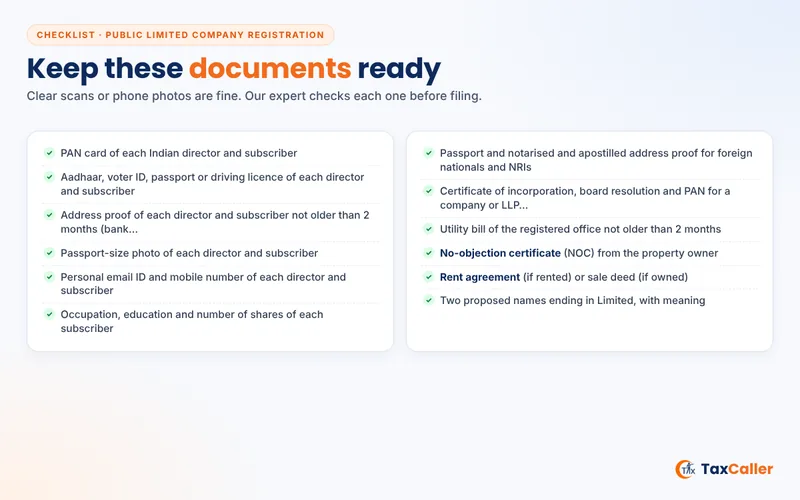
Documents for Public limited company: PAN card of each Indian director and…, Aadhaar, voter ID, passport or driving…, Address proof of each director and…, Passport-size photo of each director…, Personal email ID and mobile number of……
Public Limited Company Registration: documents to keep ready

Share clear scans or phone photos. Each person's name, date of birth and address should read the same on the PAN, the ID proof and the DSC.

From each Indian director and subscriber

  • PAN card
  • Aadhaar, voter ID, passport or driving licence
  • Address proof not older than two months: bank statement, electricity, phone or mobile bill
  • Recent passport-size photo
  • Personal mobile number and email ID
  • Occupation, education and number of shares to be taken

From foreign nationals and NRIs

  • Passport, which is mandatory for foreign nationals
  • Address proof such as a bank statement or utility bill
  • Notarised and apostilled copies, or consularised copies where the country is not in the Hague Convention

From corporate subscribers

  • Certificate of incorporation of the company or LLP
  • Board resolution approving the investment and naming a signatory
  • PAN of the entity and KYC of the authorised signatory

For the registered office

  • Electricity, water or gas bill not older than two months
  • Rent or lease agreement, or sale deed if owned
  • No-objection certificate (NOC) from the owner

Company details we need from you

  • Two proposed names ending in "Limited", with their meaning
  • Main business objects in plain words
  • Authorised and subscribed capital, face value and each subscriber's shares
  • Names of the three or more first directors, and the managing director if any

The full checklist also appears in the documents box on this page. Our expert reviews every file before filing, so the CRC does not return it for a small mismatch.

Shadab

Shadab Company Registration Expert

Have a question on this topic? Ask Shadab on a free call.

Ask an expert

← Previous Next: Company Name, Share Capital and Demat Shares →

09 Topic 9 of 23

Company Name, Share Capital and Demat Shares

Rules for the name

  • The last word must be "Limited", under Section 4(1)(a).
  • The name must not be identical or too close to an existing company or LLP, under Section 4(2) and Rule 8 of the Companies (Incorporation) Rules, 2014.
  • It must not clash with a registered trademark or a pending mark without consent, under Rule 8A.
  • Words like "Bank", "Insurance" or "Stock Exchange" need approval from the regulator, under Rule 8B.
  • Names protected by the Emblems and Names (Prevention of Improper Use) Act, 1950 are not allowed.

SPICe+ Part A lets you propose two names. An approved name stays reserved for 20 days for a new company, under Rule 9. Rule 9A allows paid extensions. We run a trademark search first, because a company name does not protect your brand. For that, file a trademark registration.

Share capital

There is no minimum capital. Authorised capital is the ceiling up to which the company can issue shares. Subscribed capital is what the subscribers agree to take. Paid-up capital is what they actually pay in. Keep authorised capital realistic, because stamp duty and ROC fees rise with it.

Face value is usually ₹10 per share. You can raise authorised capital later by an ordinary resolution and form SH-7. So there is no need to start with a large figure.

Demat shares are compulsory

Section 29(1A) and Rule 9A of the Companies (Prospectus and Allotment of Securities) Rules, 2014 require every unlisted public company to issue securities only in demat form. It must also help existing holders convert their securities. In practice this means:

  • Getting an ISIN for the shares from NSDL and CDSL through a registrar and share transfer agent (RTA).
  • Each subscriber opening a demat account before shares are credited.
  • Filing PAS-6, a half-yearly reconciliation of share capital audit report, within 60 days of each half-year end.

Nidhi companies, government companies and wholly owned subsidiaries are exempt from Rule 9A. We coordinate the RTA and ISIN steps after incorporation. RTA and depository charges are third-party costs paid at actual.

← Previous Next: Public Limited Company Registration Process: How We File SPICe+ Online →

10 Topic 10 of 23

Public Limited Company Registration Process: How We File SPICe+ Online

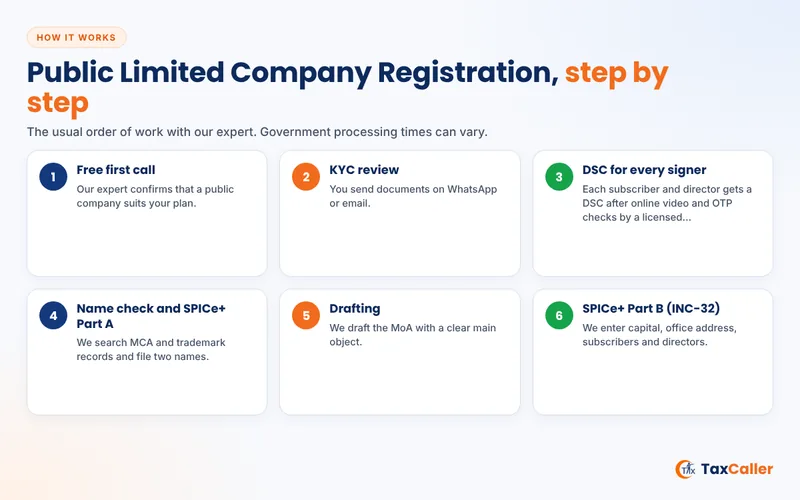
Public limited company process step by step: Free first call, KYC review, DSC for every signer, Name check and SPICe+ Part A, Drafting, SPICe+ Part B (INC-32)
Public Limited Company Registration: how the work moves, step by step

The Central Registration Centre (CRC) of the MCA processes all SPICe+ forms, wherever your office is. You do not need to visit any office. Here is our step-by-step method.

  1. Free first call: our expert confirms that a public company suits your plan. We then fix members, directors, capital and state. You get our fee and the estimated government fees in writing.
  2. KYC review: you send documents on WhatsApp or email. We match names, dates and addresses and flag mismatches early.
  3. DSC for every signer: each subscriber and director gets a DSC after online video and OTP checks by a licensed certifying authority.
  4. Name check and SPICe+ Part A: we search MCA and trademark records and file two names. The fee is ₹1,000.
  5. Drafting: we draft the MoA with a clear main object. The AoA is written for a public company, including director rotation and transfer rules.
  6. SPICe+ Part B (INC-32): we enter capital, office address, subscribers and directors. DIN is allotted in the form for up to three proposed directors.
  7. Linked forms: we prepare e-MoA (INC-33), e-AoA (INC-34) and AGILE-PRO-S (INC-35). AGILE-PRO-S covers EPFO, ESIC, a bank account request, professional tax in some states and GSTIN if you want it now.
  8. Declarations: INC-9 by subscribers and directors and DIR-2 consent by directors are generated and signed. A practising company secretary, chartered accountant or cost accountant certifies the form, as the MCA requires.
  9. Payment: forms are signed with DSCs and uploaded. Fees and stamp duty are paid on the MCA portal, and you get an SRN to track the filing.
  10. CRC queries: if the CRC asks for changes, we fix and resubmit within the time allowed.
  11. Certificate of Incorporation: the CRC issues it in form INC-11 under Section 7(2). It carries the CIN, and PAN and TAN are issued with it.
  12. After the certificate: we share a checklist for the first 180 days. It covers the bank account, INC-20A, the first auditor and demat setup.

If you have more than seven subscribers, plan for extra time. The e-MoA and e-AoA web forms have limited space for subscribers, so the MCA then asks for signed MoA and AoA as attachments. We plan this in advance so no time is lost.

Usual timeline

StageUsual time
KYC review1 working day
DSC for 7 to 10 people1 to 3 working days
Name approval1 to 3 working days
Drafting and SPICe+ Part B2 to 3 working days
CRC approval and certificate3 to 7 working days
TotalAbout 10 to 20 working days

The biggest delays come from DSC checks for seven or more people and from CRC queries. Quick replies from your side keep the total short. The MCA's own walkthrough of Part A, Part B and the linked forms is in this MCA SPICe+ guide (PDF).

← Previous Next: Commencement of Business: INC-20A Within 180 Days →

11 Topic 11 of 23

Commencement of Business: INC-20A Within 180 Days

The certificate of incorporation does not let the company start business at once. Section 10A of the Companies Act, 2013 applies to every company with share capital incorporated after 2 November 2018. Before it starts business or uses its borrowing powers, it must:

  • File a declaration by a director in form INC-20A within 180 days of incorporation.
  • Confirm that every subscriber has paid for the shares agreed in the MoA.
  • Have filed the verification of its registered office under Section 12(2).

How we handle it

  1. You open the company's current account using the certificate, PAN and a board resolution.
  2. All seven or more subscribers pay their subscription money into that account.
  3. You download the bank statement showing each receipt.
  4. We prepare INC-20A with the statement attached, signed with a director's DSC.
  5. For regulated sectors, we attach the regulator's approval, for example the RBI's for an NBFC.

If you miss it

Under Section 10A(2), the company pays a penalty of ₹50,000. Every officer in default pays ₹1,000 a day while the default continues, up to ₹1,00,000. Under Section 10A(3), the Registrar can also start striking off the company if it believes the company is not carrying on business.

An older rule you may read about

Section 11 once required a separate certificate of commencement for public companies. The Companies (Amendment) Act, 2015 removed it. Today the INC-20A declaration does that job for all companies with share capital. Guides that mention a "statutory meeting" refer to the old 1956 Act, which no longer applies.

Shreya

Shreya Company Registration Expert

Have a question on this topic? Ask Shreya on a free call.

Ask an expert

← Previous Next: Government Fees and Stamp Duty by State →

12 Topic 12 of 23

Government Fees and Stamp Duty by State

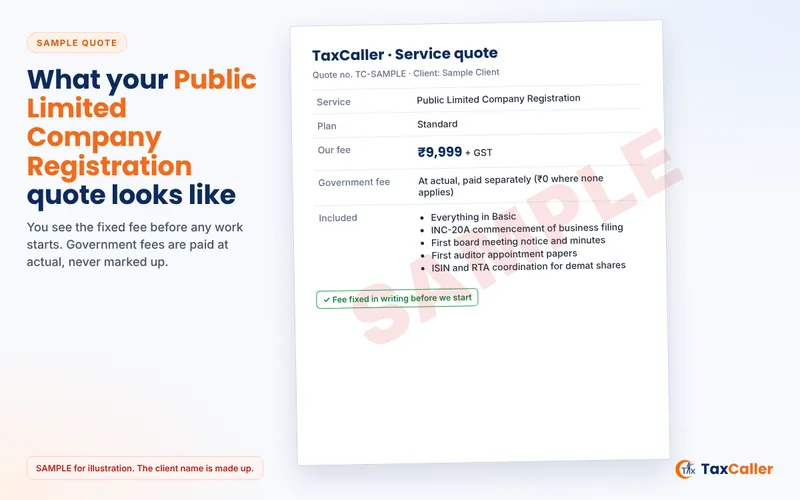
Sample TaxCaller quote for Public limited company: fixed fee plus GST, government fee paid at actual
Public Limited Company Registration: SAMPLE quote, for illustration only

This money is paid to the government or to outside providers. They are separate from TaxCaller's fee. We pay them at actual and share every receipt.

ItemAmountSource
Name reservation (SPICe+ Part A)₹1,000Companies (Registration Offices and Fees) Rules, 2014
Name validity extension₹1,000 up to 40 days; ₹2,000 more up to 60 daysRule 9A, Companies (Incorporation) Rules, 2014
SPICe+ registration fee, authorised capital up to ₹15 lakhNilMCA fee schedule
SPICe+ registration fee, capital above ₹15 lakh₹36,000 for the first ₹10 lakh, then ₹300 for each ₹10,000 up to ₹50 lakh, ₹100 for each ₹10,000 up to ₹1 crore and ₹75 for each ₹10,000 above that. The slab fee above the first ₹10 lakh is capped at ₹2.5 crore.Item 2, Table of Fees, Fees Rules, 2014, as substituted from 26 January 2018
Stamp duty on MoA, AoA and SPICe+Depends on the state and authorised capitalState stamp law, collected on the MCA portal
PAN and TAN of the companySmall fees, added to the SPICe+ paymentMCA
DSC for each subscriber and directorCharged by the certifying authorityMarket rate
RTA, ISIN and depository chargesAs charged by the RTA, NSDL and CDSLThird party
Notary and apostille for foreign papersAt actualCountry of issue

How stamp duty works

Stamp duty is a state subject. The MCA portal works it out from the state of your registered office and your authorised capital. It is collected through e-stamping when you pay for SPICe+. The same company can pay very different amounts in two states. In many states the AoA duty is a percentage of authorised capital, so a high figure raises it sharply.

Delhi NCR, Uttar Pradesh and other states

Our head office is in New Delhi, so many clients register in Delhi or Uttar Pradesh. A company with its office in Ghaziabad, Noida or elsewhere in UP comes under the ROC at Kanpur. A Delhi company comes under the ROC Delhi. Your office address decides the ROC, the stamp duty and the Regional Director.

Since 16 February 2026, Northern Region Directorate I in New Delhi has replaced the earlier Noida Regional Director office (S.O. 700(E)). Clients from any state can register with us fully online. We confirm the exact government cost for your state on the first call, before you pay anything.

In Tamil Nadu, there are two ROC offices, at Chennai and Coimbatore, and your registered office district decides which one you come under. The same rule applies everywhere: the address decides the ROC and the stamp duty, not where the directors live.

← Previous Next: Our Fees and Charges, Clarified →

13 Topic 13 of 23

Our Fees and Charges, Clarified

TaxCaller's fee covers our professional work only. Our Basic plan is priced from ₹6,999 + GST. Government fees (name fee, MCA registration fee if any, stamp duty, PAN and TAN fees) are paid separately at actual. DSC, RTA and depository charges are third-party costs.

PlanSuited toWhat is included
BasicPromoters who need the company incorporatedName search and reservation, MoA and AoA drafting, SPICe+ Part B with DIN for 3 directors, linked forms, Certificate of Incorporation, PAN and TAN
StandardFounders who want the first 180 days handledEverything in Basic, plus INC-20A, first board meeting papers, first auditor appointment papers, and ISIN and RTA coordination
PremiumCompanies that want a full first-year setupEverything in Standard, plus GST registration, Udyam registration and first-year ROC filings

When the fee can change

  • More than seven subscribers or more than three directors
  • Foreign nationals, NRIs or foreign companies as subscribers
  • Authorised capital above ₹15 lakh, which brings an ROC fee
  • Regulated objects such as NBFC, Nidhi or insurance
  • Conversion of an existing private company instead of a new registration

In these cases our expert confirms the final amount on the first call, before any payment. Nothing is added later without your approval. Yearly compliance, bookkeeping and audit support are separate services. See accounting and bookkeeping for monthly books.

← Previous Next: Independent Directors and Other Compliance Thresholds →

14 Topic 14 of 23

Independent Directors and Other Compliance Thresholds

A public company's duties grow with its size and listing status. Most limits are checked on the last audited financial statements. The table lists the main ones under the Companies Act, 2013 and its rules.

RequirementWho must complyLaw
At least 2 independent directorsUnlisted public company with paid-up capital of ₹10 crore or more, turnover of ₹100 crore or more, or loans, debentures and deposits together above ₹50 croreSection 149(4), Rule 4 of the Companies (Appointment and Qualification of Directors) Rules, 2014
One-third independent directorsEvery listed public companySection 149(4)
At least one woman directorEvery listed company; any other public company with paid-up capital of ₹100 crore or more, or turnover of ₹300 crore or moreSection 149(1), Rule 3 of the same Rules
Audit Committee and Nomination and Remuneration CommitteeSame limits as for independent directorsSections 177 and 178, Rule 6 of the Companies (Meetings of Board and its Powers) Rules, 2014
Stakeholders Relationship CommitteeMore than 1,000 shareholders, debenture holders, deposit holders and other security holdersSection 178(5)
Whole-time KMP: MD, CEO or manager, company secretary and CFOListed company; public company with paid-up capital of ₹10 crore or moreSection 203, Rule 8 of the Companies (Appointment and Remuneration of Managerial Personnel) Rules, 2014
Secretarial audit (MR-3)Listed company; public company with paid-up capital of ₹50 crore or more, or turnover of ₹250 crore or more; any company with bank borrowings of ₹100 crore or moreSection 204, Rule 9 of the same Rules
Internal auditorUnlisted public company with paid-up capital of ₹50 crore or more, turnover of ₹200 crore or more, bank borrowings above ₹100 crore, or deposits of ₹25 crore or moreSection 138, Rule 13 of the Companies (Accounts) Rules, 2014
Vigil mechanismEvery listed company; any company that accepts deposits from the public, or has borrowed more than ₹50 crore from banks and public financial institutionsSection 177(9), Rule 7 of the Meetings of Board Rules
CSR spending of 2% of average net profitNet worth of ₹500 crore or more, turnover of ₹1,000 crore or more, or net profit of ₹5 crore or moreSection 135

About independent directors

  • An independent director must meet the tests in Section 149(6) and declare independence every year.
  • The person must be listed in the databank kept by the Indian Institute of Corporate Affairs. Unless exempt, they must pass its online proficiency test.
  • A term lasts up to five years, with at most two terms in a row, under Section 149(10) and (11).
  • Independent directors do not retire by rotation.

Unlisted public companies that are joint ventures, wholly owned subsidiaries or dormant companies are exempt. They need not appoint independent directors or form the audit and nomination committees.

Rules that apply from day one

  • At least two-thirds of directors are liable to retire by rotation under Section 152(6). One-third of them retire at each AGM.
  • Total managerial pay is capped at 11% of net profit under Section 197. Members can approve more in a general meeting, within Schedule V.
  • Quorum for a general meeting is 5, 15 or 30 members present in person, based on total membership, under Section 103.
  • Board resolutions listed in Section 179(3) must be filed in MGT-14 within 30 days, under Section 117.
  • Borrowing beyond paid-up capital, free reserves and securities premium needs a special resolution under Section 180(1)(c).
Zubair

Zubair Company Registration Expert

Have a question on this topic? Ask Zubair on a free call.

Ask an expert

← Previous Next: Yearly Compliance After Incorporation →

15 Topic 15 of 23

Yearly Compliance After Incorporation

First 180 days

TaskTime limitLaw
Registered office verification, if not given in SPICe+Within 30 daysSection 12(2), INC-22
First board meetingWithin 30 daysSection 173(1)
First auditor appointed by the boardWithin 30 daysSection 139(6)
Directors disclose interests (MBP-1)At the first board meetingSection 184(1)
Subscriber shares issued, credited in demat formWithin 2 months of incorporationSection 56(4)(a), Rule 9A
INC-20AWithin 180 daysSection 10A

Every year

TaskTime limitLaw
Board meetingsAt least 4, with gaps of not more than 120 daysSection 173(1)
AGMFirst within 9 months of the first year end; then within 6 months of year endSection 96
Financial statements (AOC-4)Within 30 days of the AGMSection 137
Annual return (MGT-7)Within 60 days of the AGMSection 92
Statutory auditEvery year, whatever the turnoverSections 139 and 143
Director disclosures (MBP-1, DIR-8)First board meeting of the yearSections 184 and 164
Demat reconciliation (PAS-6)Within 60 days of each half-year endRule 9A, PAS Rules
Return of deposits (DPT-3)By 30 JuneRule 16, Companies (Acceptance of Deposits) Rules, 2014
Director KYC (DIR-3-KYC-Web)Once every 3 years, by 30 JuneRule 12A
Income-tax and TDS returnsAs per income-tax due datesIncome-tax law

A company formed on or after 1 January may close its first financial year on 31 March of the next year, under Section 2(41). A public company files the full MGT-7, because the shorter MGT-7A is only for OPCs and small companies.

Keep monthly books from the first day; our accounting and bookkeeping team can help. Tax filings are covered on our income tax filing and TDS return filing pages.

← Previous Next: Raising Capital and Listing: The Basics →

16 Topic 16 of 23

Raising Capital and Listing: The Basics

Access to capital is the main reason to choose a public company. Section 23(1) lets a public company issue securities in four ways: to the public through a prospectus, by private placement, by a rights issue or by a bonus issue.

RouteKey ruleLaw
Rights issueOffer to existing shareholders in proportion to their holdingSection 62(1)(a)
ESOPShares to employees under a scheme approved by special resolutionSection 62(1)(b)
Preferential allotmentTo chosen persons, by special resolution, with a valuation reportSection 62(1)(c)
Private placementOffer to not more than 200 persons in a financial year, not counting QIBs and ESOP employees; offer letter PAS-4; return PAS-3 within 15 days of allotmentSection 42
DebenturesSecured or unsecured, with a debenture trustee where requiredSection 71
Deposits from the publicOnly eligible public companies with net worth of ₹100 crore or more, or turnover of ₹500 crore or moreSection 76
Public issue (IPO)Prospectus filed with the ROC; SEBI rules applySections 23, 26 and 40

Listing in brief

A company that wants to list files its offer document under the SEBI (Issue of Capital and Disclosure Requirements) Regulations, 2018. Section 40(1) requires it to apply to one or more recognised stock exchanges before the issue. Smaller companies often look at the SME platforms of BSE and NSE. After listing, the SEBI (Listing Obligations and Disclosure Requirements) Regulations, 2015 add quarterly results, board rules and continuous disclosures.

SEBI sets the listing eligibility, lock-in and pricing rules, and changes them often. They are outside this registration service. We help with the company law side: capital structure, demat, board composition and ROC filings. For the issue itself, you need a SEBI-registered merchant banker.

Raising money is regulated

Never collect money from the public through informal "investment plans". Under Section 42, an offer to more persons than private placement allows is treated as a public offer. That needs a full prospectus and attracts heavy penalties if skipped. Plan every fund raise with your adviser before you speak to investors.

How the public buys shares

In the primary market, investors apply for new shares in an IPO or a follow-on offer through their bank or broker. The money goes to the company. In the secondary market, investors buy and sell already issued shares on BSE or NSE through a broker and a demat account. That money goes to the selling shareholder, not the company. Shares of an unlisted public company change hands through private deals, still in demat form.

← Previous Next: Examples from India and How to Find the Company List →

17 Topic 17 of 23

Examples from India and How to Find the Company List

Most large Indian businesses you know are public limited companies. Their names end with "Limited", without the word "Private".

Well-known examples

  • Reliance Industries Limited
  • Tata Consultancy Services Limited
  • Infosys Limited
  • Larsen & Toubro Limited

All four are listed on BSE and NSE. But listing is not what makes them public. Thousands of unlisted public companies also exist, such as Nidhi companies, many infrastructure project companies and subsidiaries of listed groups.

Names like Apple or Coca-Cola often appear as examples online. They are companies formed under foreign law, not public limited companies under the Indian Companies Act.

How to check if a company is public

  1. Open the MCA portal and use the company master data search.
  2. Enter the name or CIN.
  3. Read the "Class of Company" field. It shows Public or Private.
  4. Check the listing status and the company status, such as Active or Strike Off.

The CIN also tells you a lot. Its first letter is L for a listed company and U for an unlisted one. Characters 13 to 15 show the type, such as PLC for a public limited company or PTC for a private one.

Where to get a full company list

There is no single printed list. The MCA's company master data covers every registered company. For listed companies, BSE and NSE publish lists of companies whose shares trade on them. A list of large unlisted public companies can only be built from MCA data, usually through a paid data provider.

Abhinay Rai

Abhinay Rai Company Registration Expert

Have a question on this topic? Ask Abhinay on a free call.

Ask an expert

← Previous Next: Converting a Private Limited Company Into a Public Company →

18 Topic 18 of 23

Converting a Private Limited Company Into a Public Company

Many companies start as private and convert when investors or listing plans arrive. Section 14 lets a private company become public by altering its articles. Section 18 governs the conversion and the fresh certificate.

Steps

  1. Board meeting: approve the proposal, the altered MoA and AoA, and the notice of an EGM.
  2. Meet the minimums: bring members to at least 7 and directors to at least 3. This is done through share transfers, allotment and director appointments.
  3. EGM: pass a special resolution under Section 14(1)(b) to alter the articles. This removes the private company limits of Section 2(68). The same meeting changes the name by dropping "Private", under Section 13.
  4. MGT-14: file the special resolution with the ROC within 30 days, under Section 117.
  5. INC-27: file the conversion form with the altered MoA and AoA, minutes and resolution.
  6. New certificate: the ROC issues a fresh certificate of incorporation with the new name. The CIN shows "PLC" in place of "PTC".
  7. Update records: change the name on PAN, TAN, GST, bank account, letterheads, website and contracts.

What changes after conversion

  • All shares move to demat form under Rule 9A, with an ISIN.
  • Many board resolutions are filed in MGT-14.
  • Managerial pay must stay within Section 197.
  • Loans to directors, related party deals and borrowing follow public company rules.
  • Small company relief ends, because a public company cannot be a small company.

The reverse move, public to private, needs approval of the Regional Director under the proviso to Section 14(1). Draft incorporation rules published in April 2026 propose one new form, E-CON, in place of INC-27 and related forms. This is only a draft. Until final rules are notified, INC-27 and the current forms apply.

Running a proprietorship or partnership today? Most owners first form a private limited company and convert later. Our expert can map the right path on a free call.

The reverse move: public to private

A public company can also become private. It passes a special resolution to alter its articles under Section 14(1). The second proviso to Section 14(1) then needs Central Government approval, which the Regional Director gives. The company applies in form RD-1 within 60 days of the resolution. It then files the approval order with the ROC in form INC-27 within 15 days. Members and creditors can object, so plan it with care.

← Previous Next: Penalties Under the Companies Act →

19 Topic 19 of 23

Penalties Under the Companies Act

Most defaults carry a fixed penalty. The table lists the ones a new public company meets first.

DefaultPenaltySection
INC-20A not filed within 180 daysCompany ₹50,000; each officer ₹1,000 a day, up to ₹1,00,000Section 10A(2)
Registered office not kept or verifiedCompany and each officer ₹1,000 a day, up to ₹1,00,000Section 12(8)
Any e-form filed lateAdditional fee of ₹100 a day for each formSection 403, Fees Rules
Annual return not filedCompany ₹10,000 plus ₹100 a day, up to ₹2 lakh; officer up to ₹50,000Section 92(5)
Financial statements not filedCompany ₹10,000 plus ₹100 a day, up to ₹2 lakh; officer up to ₹50,000Section 137(3)
Resolution not filed in MGT-14Company ₹10,000 plus ₹100 a day, up to ₹2 lakh; officer up to ₹50,000Section 117(2)
No whole-time KMP when requiredCompany ₹5 lakh; each director and KMP ₹50,000 plus ₹1,000 a day, up to ₹5 lakhSection 203(5)
AGM not heldFine up to ₹1 lakh, plus up to ₹5,000 a day while it continuesSection 99
Default with no specific penalty₹10,000 plus ₹1,000 a day; up to ₹2 lakh for the company and ₹50,000 for an officerSection 450
Filings missed for 3 years in a rowDirectors disqualified for 5 yearsSection 164(2)

Section 446B halves penalties only for OPCs, small companies, start-up companies and producer companies. A public company cannot be a small company under Section 2(85), so it usually pays the full amount.

In February 2026, the MCA re-notified ROCs as adjudicating officers under Section 454, with revised jurisdiction (S.O. 698(E)). A penalty notice now usually starts with your ROC, and appeals go to the Regional Director.

Closing a public company

A company that has stopped business can apply to the ROC to remove its name under Section 248(2), in form STK-2. A company can also be wound up by the National Company Law Tribunal under Section 271, for example after a special resolution or on just and equitable grounds. Inability to pay debts is now dealt with under the Insolvency and Bankruptcy Code. Solvent companies can choose voluntary liquidation under the Insolvency and Bankruptcy Code, 2016.

← Previous Next: Common Mistakes and ROC Rejection Reasons →

20 Topic 20 of 23

Common Mistakes and ROC Rejection Reasons

Most hold-ups trace back to a handful of errors you can avoid.

  • Choosing public for prestige: paying for public company compliance with no funding plan.
  • Signers not ready: one of seven subscribers delays DSC or KYC, and the whole filing waits.
  • "Private" left in the name: a public company name must end with "Limited" alone.
  • Close or trademarked names: names that look like existing companies or marks are rejected under Rules 8 and 8A.
  • Old proofs: utility bills or bank statements older than two months.
  • Mismatched details: spelling or date of birth differs between PAN, Aadhaar and DSC.
  • No resident director: a board of people living abroad fails Section 149(3).
  • Disqualified director: a person whose DIN is deactivated or who is disqualified under Section 164.
  • Vague objects: a main object that does not describe the real business.
  • Regulated business without approval: lending, deposits, insurance or chit funds need regulator consent.
  • High authorised capital: it pushes up stamp duty and ROC fees for no gain.
  • Skipping demat: physical share certificates in an unlisted public company break Rule 9A.
  • Forgetting INC-20A: no bank proof of subscription money within 180 days.

We check each point before filing. That saves you from resubmissions and lapsed name approvals.

Shadab

Shadab Company Registration Expert

Have a question on this topic? Ask Shadab on a free call.

Ask an expert

← Previous Next: What Changed in 2026 for Public Companies →

21 Topic 21 of 23

What Changed in 2026 for Public Companies

These are official changes, plus two proposals that are not law yet. We update this page when the MCA notifies new rules.

1. Director KYC once every three years

The Companies (Appointment and Qualification of Directors) Amendment Rules, 2025 (G.S.R. 943(E), dated 31 December 2025) took effect on 31 March 2026. Directors now file DIR-3-KYC-Web once every three financial years, by 30 June after the block ends. A change in mobile number, email or address must be reported within 30 days. Every public company has at least three directors, so this cuts yearly filings. If KYC is not filed, the DIN is deactivated, and reactivation costs ₹5,000 under the fee rules.

2. ROC adjudication and new Regional Director offices

Notifications dated 10 February 2026 re-appointed ROCs as adjudicating officers under Section 454 (S.O. 698(E)). They also raised the Regional Director offices from seven to ten, effective 16 February 2026 (S.O. 699(E)). For the north, the Noida office was replaced by Northern Region Directorate I in New Delhi (S.O. 700(E)). Conversions and other approvals now go to the revised Regional Director for your state.

3. Draft Companies (Incorporation) Amendment Rules, 2026

On 8 April 2026, the MCA published draft rules for public comment until 9 May 2026. They propose DIN for up to five directors in SPICe+ and no separate DIR-12 for first directors. They also widen proof options for the registered office and merge INC-27 and other conversion forms into one form, E-CON. These are draft proposals only. As of November 2026 we have not seen them notified as final rules, so current forms and the three-DIN limit apply.

4. Corporate Laws (Amendment) Bill, 2026

The Bill was introduced in the Lok Sabha on 23 March 2026 and sent to a Joint Parliamentary Committee. The committee reported on 3 August 2026. The Bill proposes AGMs by video conference with a physical meeting at least once in three years. It also proposes a higher CSR net profit trigger of ₹10 crore, new buy-back limits and recognition of RSUs and SARs. It is a Bill, not law. As of November 2026 it has not been passed, so the current Act applies.

5. New Income-tax Act from 1 April 2026

The Income-tax Act, 2025 is in force from 1 April 2026 and replaces the 1961 Act. Previous year and assessment year are replaced by the term "tax year". A public company is taxed like any other domestic company. The 22% concessional option, earlier in section 115BAA, sits in section 200 of the new Act from tax year 2026-27. For financial year 2025-26, the company files its return under the 1961 Act.

6. CSR through Social Stock Exchange instruments

The Companies (Corporate Social Responsibility Policy) Amendment Rules, 2026 (G.S.R. 415(E), dated 27 May 2026) added Rule 4A. A company may now route up to 10% of its total CSR spending for the year through zero coupon zero principal instruments. These are issued by not-for-profit bodies registered on a Social Stock Exchange. This matters for larger public companies that cross the Section 135 limits.

7. MCA21 outage relief

A fire hit the MCA21 data centre on 5 June 2026. The MCA then extended name reservations and resubmission deadlines that fell in late June 2026 to 10 July 2026. The lesson for new filings: keep a buffer before your name approval expires.

← Previous Next: Why TaxCaller for Your Public Company →

22 Topic 22 of 23

Why TaxCaller for Your Public Company

  • Honest structure advice: if a private company or LLP suits you better, we say so on the first call.
  • Clear costs: our fee and the government fees are shown separately in writing before work starts.
  • Many signers, one tracker: we follow up DSC and KYC for all seven or more subscribers, so one delay does not stall the file.
  • Articles written for a public company: not a private company template with a few words changed.
  • After-incorporation support: INC-20A, the first auditor, demat and ISIN steps on one checklist.
  • Expert review: our process and this page are reviewed by Abhinay Rai, Advocate.
  • Serving clients since 2018: from our head office in New Delhi, fully online across India.

Want to talk first? Contact us to book a free call with our expert.

← Previous Next: Official Sources and Registrations to Plan Next →

23 Topic 23 of 23

Official Sources and Registrations to Plan Next

A new public company usually needs a few more registrations and filings. Each has its own page.

Official sources

Shreya

Shreya Company Registration Expert

Have a question on this topic? Ask Shreya on a free call.

Ask an expert

← Previous

Quick checklist before you start

Don't have everything? Send what you have on WhatsApp. Our expert will tell you what's missing.

Send documents on WhatsApp
  • PAN card of each Indian director and subscriber
  • Aadhaar, voter ID, passport or driving licence of each director and subscriber
  • Address proof of each director and subscriber not older than 2 months (bank statement or utility bill)
  • Passport-size photo of each director and subscriber
  • Personal email ID and mobile number of each director and subscriber
  • Occupation, education and number of shares of each subscriber
  • Passport and notarised and apostilled address proof for foreign nationals and NRIs
  • Certificate of incorporation, board resolution and PAN for a company or LLP subscriber
  • Utility bill of the registered office not older than 2 months
  • No-objection certificate (NOC) from the property owner
  • Rent agreement (if rented) or sale deed (if owned)
  • Two proposed names ending in Limited, with meaning
  • Main business objects in plain words
  • Authorised and subscribed capital, face value and shareholding pattern
  • Names of at least 3 directors, with at least one resident in India

Why TaxCaller

Real experts, not a call centre

Your work is handled by experienced professionals who explain every step, check your documents and keep you updated.

Registered company

TaxCaller is run by TaxCaller India LLP (LLPIN AAQ-7388), serving clients since 2018.

Fee told upfront

You know the complete fee, our professional fee and the government fee, before any work starts. No hidden charges.

Support after the work

Notices, renewals, returns and compliance reminders: we stay with your business after the registration is done.

Reviewed By

Abhinay Rai

Expert for this topic Public Limited Company Registration

Abhinay Rai

Advocate

Abhinay Rai is a Advocate specialising in Public Limited Company Registration. The process, documents, timelines and fees on this page are checked against the current rules and government portals, and updated whenever the law, forms or fees change.

Reviewed byAbhinay Rai
Content updated
View LinkedIn Profile

Public Limited Company Registration: your questions answered

What is a public limited company in simple words?

It is a company whose shares can be held by any number of people and offered to the public. It needs at least seven members and three directors, and its name ends with "Limited". Members are liable only for unpaid share money. It may stay unlisted, or list on a stock exchange later under SEBI rules.

Who is the owner of a public limited company?

The shareholders own a public limited company, each in proportion to the shares held. The board of directors, elected by the shareholders, manages it. Promoters often hold a large stake at the start, but ownership spreads as more shares are issued. The company itself owns its assets, because it is a separate legal person under Section 9.

How many members and directors are needed to register a public limited company?

You need at least seven members under Section 3(1)(a), and at least three directors under Section 149(1). There is no upper limit on members. A company can have up to 15 directors, or more with a special resolution. One director must be resident in India. The same people can be both members and directors.

Is there a minimum capital for a public limited company?

No. The Companies (Amendment) Act, 2015 removed the old ₹5 lakh minimum paid-up capital. You can start with any sensible amount. However, every subscriber must pay for the shares they take, and the company must file INC-20A within 180 days. Keep authorised capital realistic, because stamp duty and ROC fees rise with it.

How long does public limited company registration take?

It usually takes 10 to 20 working days after we receive complete documents. DSCs for seven or more people take one to three days. Name approval takes one to three days, and CRC approval three to seven days. Most delays come from late KYC, mismatched documents or CRC queries, so quick replies keep the timeline short.

How much does it cost to register a public limited company in India?

The cost has two parts. Government fees include ₹1,000 for the name, state stamp duty, PAN and TAN fees, and an ROC fee only if authorised capital is above ₹15 lakh. DSCs cost extra. TaxCaller's professional fee is charged plus GST. Our expert gives you a full written estimate on a free first call.

Does a public limited company have to be listed on a stock exchange?

No. Most public companies stay unlisted for years. Listing is a separate step that needs a public issue under SEBI's ICDR Regulations and approval from a stock exchange. An unlisted public company can still have unlimited shareholders and freely transferable shares. It must, however, keep its shares in demat form under Rule 9A.

Can NRIs or foreign nationals be directors or shareholders?

Yes. NRIs and foreign nationals can be subscribers and directors, subject to the FDI rules for your sector. Their documents must be notarised and apostilled, or consularised. Each director needs a DIN and a DSC. At least one director must have stayed in India for 182 days or more in the financial year, under Section 149(3).

What is INC-20A and when must it be filed?

INC-20A is the declaration for commencement of business under Section 10A. A director files it within 180 days of incorporation, with bank proof that every subscriber has paid for their shares. The company should not start business or borrow before filing it. Missing it costs the company ₹50,000, plus daily penalties for officers.

When does a public company need independent directors?

A listed company needs one-third of its board to be independent. An unlisted public company needs at least two once paid-up capital reaches ₹10 crore, turnover reaches ₹100 crore, or loans, debentures and deposits exceed ₹50 crore, under Rule 4. Unlisted joint ventures, wholly owned subsidiaries and dormant companies are exempt.

Can a private limited company be converted into a public company?

Yes. Under Sections 14 and 18, members pass a special resolution to alter the articles and drop "Private" from the name. The company must first have seven members and three directors. MGT-14 and INC-27 are filed with the ROC, which issues a fresh certificate of incorporation. Public company rules apply from that date.

Must the shares of an unlisted public company be in demat form?

Yes. Since 2 October 2018, Rule 9A of the Companies (Prospectus and Allotment of Securities) Rules, 2014 requires unlisted public companies to issue securities only in demat form. The company needs an ISIN through a registrar and transfer agent, and files PAS-6 every half-year. Nidhi companies, government companies and wholly owned subsidiaries are exempt.

Can a public limited company raise money from the public without an IPO?

Partly. It can raise funds through private placement to up to 200 persons a year under Section 42, rights issues, preferential allotment and debentures. Only eligible large companies can take deposits from the public, under Section 76. Any wider invitation to the public needs a prospectus, which brings SEBI rules into play.

What annual compliances does a public limited company have?

Every year it holds at least four board meetings and an AGM, gets its accounts audited, and files AOC-4 and MGT-7 with the ROC. It also files MGT-14 for key board resolutions, PAS-6 for demat reconciliation, DPT-3 and income-tax returns. Larger companies add independent directors, committees and a secretarial audit.

Is a statutory meeting still required for a public company?

No. The statutory meeting and statutory report were rules of the old Companies Act, 1956. The Companies Act, 2013 has no such requirement. A new public company must instead hold its first board meeting within 30 days, file INC-20A within 180 days, and hold its first AGM within nine months of its first year end.

Start your public limited company with a tax expert

Book a free call to check whether a public company suits your plans and get your full cost in writing. Our fee starts at ₹6,999 + GST, with government fees shown separately.

Mon–Fri 9:00 AM – 6:00 PM, Sat 10:00 AM – 4:00 PM · Your trust is our biggest fee.

Request a callback

+91

No spam calls. Your details stay 100% private. Privacy Policy