

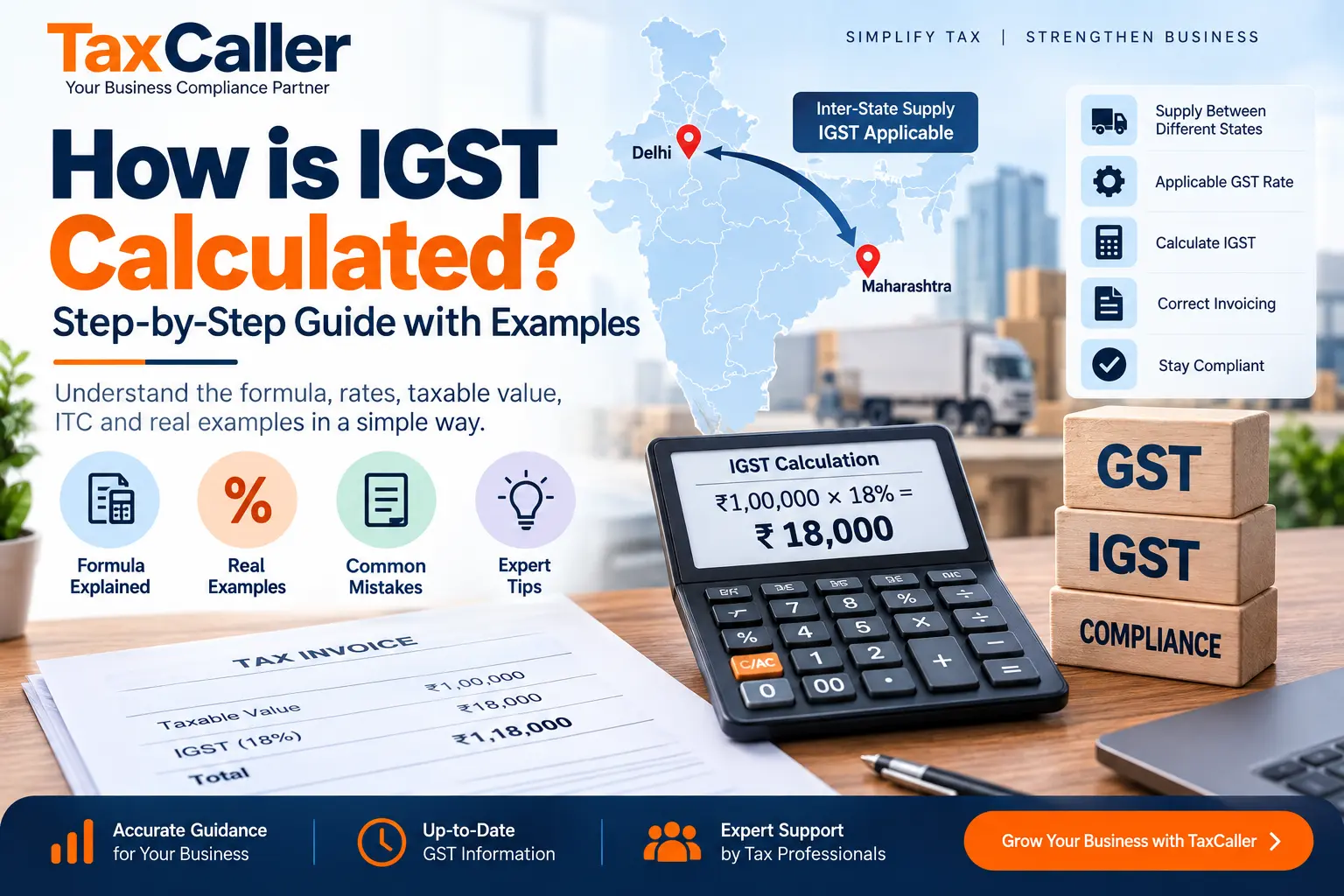
In general, IGST (Integrated Goods and Services Tax) is applicable on inter-State supplies of goods or services. To calculate IGST, you need to first determine the taxable value of the supply, then find out the rate of GST applicable and finally apply the IGST rate to such taxable value. This guide covers the formula for IGST calculation, real-world examples, Input Tax Credit, invoices, common mistakes and compliance considerations.
Table of Contents
- Direct Answer
- Quick Summary
- What is IGST?
- When is IGST Applicable?
- IGST Calculation Formula
- How to Calculate IGST Step-by-Step
- IGST Calculation Examples
- IGST vs CGST and SGST
- IGST and Input Tax Credit
- IGST on Imports and Exports
- IGST on Invoices
- How GST Registration Relates to IGST
- Common IGST Calculation Mistakes
- Expert Advice from TaxCaller
- Frequently Asked Questions
- Official Government References
- Internal Links for TaxCaller
- Conclusion
Direct Answer
The general method of computation of IGST is taxable value of inter-State supply multiplied by the applicable rate of GST. For instance, if a product has a taxable value of ₹1,00,000 and the applicable GST rate is 18%, the IGST will be ₹18,000 and the invoice value will be ₹1,18,000 excluding any eligible discounts or other applicable adjustments.
Quick Summary
- IGST means Integrated Goods and Services Tax.
- It is generally charged on inter-State supplies of goods or services.
- The first step is to determine whether the transaction is an inter-State supply.
- Next, determine the taxable value of the supply.
- Identify the correct GST rate applicable to the goods or services.
- Use the formula: IGST = Taxable Value × IGST Rate.
- For a taxable value of ₹1,00,000 at 18%, IGST is ₹18,000.
- Total invoice value before other adjustments would be ₹1,18,000.
- Eligible Input Tax Credit may reduce the net GST liability payable through the electronic credit ledger, subject to applicable conditions.
- The correct place-of-supply rules are important when determining whether IGST applies.
- Exports and supplies to SEZ units/developers are treated as zero-rated supplies subject to the applicable provisions.
- Businesses should verify the applicable GST rate and place-of-supply treatment before issuing invoices or filing returns.
What is IGST?
IGST means Integrated Goods and Services Tax If a supply qualifies as an inter-State supply, then generally it is the component of GST which is applicable.
The Integrated Goods and Services Tax Act, 2017 levies IGST on all inter-State supplies of goods or services or both subject to the provisions of the law. The tax shall be levied on the value as determined under the applicable valuation provisions of the Central Goods and Services Tax Act.
Say for example, a registered business in Maharashtra sells taxable goods to a registered customer in Uttar Pradesh. Where the transaction is an inter-State supply, IGST may be applicable instead of CGST and SGST.
Basic GST Concept
Inter-State taxable supply → IGST
Whereas, broadly:
Intra-State taxable supply → CGST + SGST/UTGST
The actual tax treatment depends on the applicable provisions, including the place of supply.
When is IGST Applicable?
IGST is generally relevant when a transaction is treated as an inter-State supply.
Common situations include:
1. Sale of Goods Between Different States
If a seller located in one State supplies goods to a buyer located in another State, the transaction may qualify as an inter-State supply.
Example:
A supplier in Delhi sells goods to a business in Uttar Pradesh.
If the supply is an inter-State supply:
GST component = IGST
2. Inter-State Supply of Services
IGST can also apply to qualifying inter-State supplies of services.
For services, determining the place of supply can be particularly important because the location of the supplier and recipient, along with the specific nature of the service and applicable rules, can affect the tax treatment.
3. Imports
Imported goods are subject to IGST in accordance with the applicable customs and GST provisions. The IGST Act specifically provides for IGST on imported goods through the relevant customs framework.
4. Zero-Rated Supplies
Exports of goods or services and supplies to SEZ developers or SEZ units qualify as zero-rated supplies under Section 16 of the IGST Act, subject to the applicable conditions.
IGST Calculation Formula
The basic formula for calculating IGST is:
Example
Taxable Value = ₹1,00,000
IGST Rate = 18%
Therefore:
IGST = ₹1,00,000 × 18 ÷ 100
IGST = ₹18,000
Total amount:
₹1,00,000 + ₹18,000 = ₹1,18,000
This is the basic calculation when the stated amount is the taxable value before GST.
However, actual invoicing may require consideration of discounts, other charges forming part of value, valuation provisions and the applicable GST rate.
How to Calculate IGST Step-by-Step
Step 1: Identify the Supplier's Location
First, identify where the supplier is located.
Example:
Supplier: Delhi
Step 2: Identify the Recipient's Location
Next, identify the location of the recipient.
Example:
Recipient: Uttar Pradesh
Step 3: Determine the Place of Supply
The relevant GST treatment can be determined by considering the place-of-supply provisions.
The rules for goods and services can be different depending on the type of transaction.
This is an important step as the correct tax treatment can not always be determined by simply looking at the billing address.
Step 4: Determine Whether the Supply is Inter-State
If the applicable rules classify the transaction as an inter-State supply, IGST may apply.
Step 5: Determine the Taxable Value
Calculate the taxable value after considering the applicable valuation rules.
Suppose:
- Product value = ₹2,00,000
- Eligible discount = ₹20,000
Assuming the discount is appropriately deductible under the applicable GST valuation provisions:
Taxable value = ₹1,80,000
Step 6: Identify the Applicable GST Rate
Determine the applicable rate for the specific goods or services.
Example:
Applicable rate = 18%
Step 7: Calculate IGST
Use:
₹1,80,000 × 18% = ₹32,400
Therefore:
IGST = ₹32,400
Step 8: Calculate the Invoice Total
| Component | Amount |
|---|---|
| Taxable Value | ₹1,80,000 |
| IGST | ₹32,400 |
| Total | ₹2,12,400 |
Step 9: Record the Transaction Correctly
The invoice and accounting records should reflect the appropriate taxable value, rate, IGST amount and other mandatory information applicable to the transaction.
Step 10: Report the Transaction in GST Compliance
The transaction should be reported in the appropriate GST return or statement according to the taxpayer's applicable filing requirements.
IGST Calculation Examples
Example 1: Simple 18% IGST Calculation
A Delhi business sells goods worth ₹50,000 to a customer in Uttar Pradesh.
Assume the transaction qualifies as an inter-State supply and the applicable GST rate is 18%.
- Taxable Value: ₹50,000
- IGST: ₹50,000 × 18%
- IGST: ₹9,000
- Total Invoice Value: ₹59,000
Example 2: IGST at 12%
Suppose a taxable inter-State supply has a taxable value of ₹75,000 and the applicable GST rate is 12%.
- IGST = ₹75,000 × 12%
- IGST = ₹9,000
- Invoice Value = ₹84,000
Example 3: IGST at 5%
Suppose the taxable value is ₹40,000 and the applicable GST rate is 5%.
- IGST = ₹40,000 × 5%
- IGST = ₹2,000
- Invoice Value = ₹42,000
Example 4: Service Transaction
A consultant provides a qualifying inter-State service for a taxable value of ₹2,00,000.
Assume the applicable GST rate is 18%.
- IGST = ₹2,00,000 × 18%
- IGST = ₹36,000
- Total Invoice = ₹2,36,000
The exact tax treatment should be determined after examining the applicable place-of-supply and classification provisions.
IGST Calculation Table
| Taxable Value | GST Rate | IGST | Total Invoice |
|---|---|---|---|
| ₹10,000 | 5% | ₹500 | ₹10,500 |
| ₹25,000 | 12% | ₹3,000 | ₹28,000 |
| ₹50,000 | 18% | ₹9,000 | ₹59,000 |
| ₹1,00,000 | 18% | ₹18,000 | ₹1,18,000 |
| ₹2,00,000 | 28% | ₹56,000 | ₹2,56,000 |
These are illustrative calculations. The applicable rate depends on the classification and current GST rate applicable to the particular supply.
IGST vs CGST and SGST
One of the most common GST questions is whether to charge IGST or CGST plus SGST.
| Particular | IGST | CGST + SGST |
|---|---|---|
| Typical application | Inter-State supply | Intra-State supply |
| Tax structure | Single integrated tax component | Central + State components |
| Example | Delhi → Uttar Pradesh | Delhi → Delhi |
| Calculation | Taxable value × IGST rate | Taxable value × respective CGST/SGST rates |
| Invoice presentation | IGST shown separately | CGST and SGST shown separately |
| Place of supply | Important | Important |
Example
Suppose taxable value is ₹1,00,000 and total GST rate is 18%.
For a qualifying inter-State supply:
IGST = ₹18,000
For a qualifying intra-State supply:
CGST = ₹9,000
SGST = ₹9,000
Therefore, the total GST in both examples is ₹18,000, but the tax components are different.
IGST and Input Tax Credit
Input Tax Credit, commonly called ITC, allows an eligible registered taxpayer to claim credit of input tax subject to the applicable conditions and restrictions.
The CGST Act provides for eligible input tax credit on supplies used or intended to be used in the course or furtherance of business, subject to the statutory conditions.
Suppose:
Output IGST = ₹50,000
and an eligible taxpayer has:
Available ITC = ₹30,000
The net tax liability, assuming the credit is fully eligible and can be utilised against the relevant liability under the applicable rules, would be reduced by the available credit.
| Output tax | ₹50,000 |
|---|---|
| Eligible ITC utilised | ₹30,000 |
| Remaining liability | ₹20,000 |
However, businesses should not assume that every input tax amount can automatically be utilised. Eligibility, documentation, restrictions, matching/reconciliation and utilisation rules need to be considered.
IGST on Imports and Exports
IGST on Imports
The provisions of IGST applicable to imported goods are implemented through the customs framework. Section 5 of the IGST Act, 2017 deals specifically with IGST on import of goods and refers to the Customs Tariff Act, 1975 for the mechanism of levy and collection.
As you can see the calculation for imports can be a bit more complicated than just applying a GST rate to the value of the supplier invoice.
Importers need to consider the applicable customs valuation, duties and other related components while computing the IGST payable.
IGST on Exports
Exports are treated as zero-rated supplies under Section 16 of the IGST Act. Supplies to SEZ developers or SEZ units can also qualify as zero-rated supplies subject to the applicable provisions.
The IGST Act provides mechanisms for zero-rated supplies, including supplies made without payment of integrated tax under the applicable conditions and supplies made on payment of integrated tax followed by a claim for refund, subject to the statutory requirements.
IGST on GST Invoices
When IGST applies, the tax invoice should correctly identify the relevant transaction and tax details required under the applicable GST rules.
Example Invoice Calculation
| Invoice Component | Amount |
|---|---|
| Product Value | ₹1,00,000 |
| Taxable Value | ₹1,00,000 |
| IGST Rate | 18% |
| IGST | ₹18,000 |
| Total Invoice Value | ₹1,18,000 |
Businesses should ensure that the GSTINs, place of supply, HSN/SAC, taxable value, applicable rate and tax amount are correctly recorded wherever applicable.
An incorrect place of supply or tax classification can result in incorrect tax reporting.
How GST Registration Relates to IGST
Businesses that regularly make taxable supplies should determine whether GST registration is required under the applicable GST provisions.
Businesses can apply for GST Registration Online through the official GST Portal. The GST Portal's registration guide states that applicants can access the GST website and select Services → Registration → New Registration to begin the registration application.
For businesses that need professional assistance, TaxCaller provides support related to:
Businesses should determine their registration requirements based on their facts, turnover, nature of supply and applicable legal provisions.
Common IGST Calculation Mistakes
1. Charging IGST Without Checking Place of Supply
Businesses sometimes assume that different State addresses automatically determine the tax treatment.
The applicable place-of-supply rules should be checked before determining whether IGST applies.
2. Using the Wrong GST Rate
Different goods and services may attract different GST rates.
Using an incorrect rate can result in short payment or excess collection.
3. Calculating Tax on the Wrong Value
IGST should be calculated on the applicable taxable value rather than automatically using an arbitrary invoice amount.
4. Confusing IGST With CGST + SGST
An inter-State supply and an intra-State supply can have different GST components even when the overall GST rate is the same.
5. Incorrect GSTIN
A wrong GSTIN can create serious reporting and reconciliation problems.
6. Ignoring Credit Eligibility
Businesses sometimes treat all GST paid on purchases as automatically available for ITC.
ITC is subject to applicable statutory conditions and restrictions.
7. Not Reconciling GST Data
Businesses should reconcile invoices, books, GST returns and available tax-credit information to identify mismatches.
8. Incorrect Treatment of Exports
Export transactions require careful consideration because exports are zero-rated supplies subject to specific conditions and refund mechanisms.
Expert Advice from TaxCaller
Correct IGST calculation is not only about multiplying the taxable value by a percentage.
A reliable GST compliance process should generally follow this sequence:
For example, a business should not start by asking:
“Should I charge 18% IGST?”
Instead, it should first establish:
- What is being supplied?
- Who is supplying it?
- Who is receiving it?
- Where is the supplier located?
- Where is the recipient located?
- What is the applicable place of supply?
- Is the supply inter-State?
- What is the taxable value?
- What GST rate applies?
- Is ITC available to the recipient?
This approach reduces the risk of incorrect GST classification and tax reporting.
TaxCaller assists businesses with GST-related services including GST Registration, GST Filing, GST compliance, GST return support and tax-related professional services.
Frequently Asked Questions
1. How is IGST calculated?
IGST is generally calculated by multiplying the taxable value of an inter-State supply by the applicable IGST rate. For example, if the taxable value is ₹1,00,000 and the applicable rate is 18%, the IGST is ₹18,000. The total invoice value, before other applicable adjustments, would therefore be ₹1,18,000.
2. What is the formula for calculating IGST?
The basic formula is IGST = Taxable Value × Applicable IGST Rate ÷ 100. For example, on a taxable value of ₹50,000 at an 18% rate, the calculation is ₹50,000 × 18 ÷ 100, resulting in IGST of ₹9,000. The applicable taxable value and rate should always be determined according to GST provisions.
3. When is IGST charged?
IGST is generally charged on supplies that qualify as inter-State supplies under the applicable GST provisions. This can include certain supplies of goods and services between different States or Union Territories. The place-of-supply provisions are important because the GST treatment depends on the legal classification of the transaction.
4. What is the difference between IGST and CGST plus SGST?
IGST is generally used for qualifying inter-State supplies, while CGST and SGST/UTGST are generally applicable to qualifying intra-State supplies. For example, an inter-State supply with an 18% GST rate may have 18% IGST, while an intra-State supply may have 9% CGST and 9% SGST.
5. Can IGST Input Tax Credit be claimed?
An eligible registered taxpayer may claim Input Tax Credit subject to the conditions, restrictions and utilisation provisions under GST law. Businesses should maintain appropriate tax invoices and records and verify credit eligibility before claiming or utilising ITC. Not every tax amount paid on purchases is automatically available as unrestricted credit.
6. How is IGST calculated on an invoice?
To calculate IGST on an invoice, determine the applicable taxable value, identify whether the transaction qualifies as an inter-State supply, determine the applicable GST rate and multiply the taxable value by that rate. The resulting amount is the IGST component, which is then added to the taxable value to determine the invoice total.
7. Is IGST applicable to services?
IGST can apply to qualifying inter-State supplies of services. However, services require careful examination of the applicable place-of-supply rules, supplier location, recipient location and nature of the service. Businesses should not determine IGST applicability only by looking at the location mentioned on an invoice or payment document.
8. Is IGST applicable on exports?
Exports of goods or services are treated as zero-rated supplies under the IGST Act, subject to applicable conditions. The law provides mechanisms for making zero-rated supplies, including supplies under the applicable bond or Letter of Undertaking framework and supplies on payment of IGST followed by a refund claim.
9. How is IGST calculated on imports?
IGST on imported goods is governed by the applicable customs and GST provisions. The IGST Act provides that IGST on imported goods is levied and collected under the relevant Customs Tariff Act mechanism. Therefore, import IGST calculation can involve customs valuation and other applicable components rather than simply applying GST to the overseas supplier's invoice.
10. Can I calculate IGST online?
Yes, businesses can use online GST calculation tools to estimate IGST after entering the taxable value and applicable GST rate. However, an online calculation should not replace checking the correct classification, place of supply, valuation rules, applicable rate, ITC eligibility and other GST compliance requirements relevant to the transaction.
Official Government References
For authoritative GST information, businesses should refer to official government resources, including:
CBIC – Integrated Goods and Services Tax Act
The official CBIC publication of the IGST Act contains provisions relating to the levy and collection of IGST, zero-rated supplies and other matters.
View the IGST Act on the CBIC website
GST Portal – New GST Registration
The official GST Portal provides the registration process for taxpayers applying for GST registration. The government guide explains the New Registration process through the GST Portal.
CBIC – Input Tax Credit
CBIC also provides information relating to GST Input Tax Credit rules and related provisions.
CBIC – Central Goods and Services Tax Act
The CGST Act contains important provisions relating to Input Tax Credit and other aspects of GST administration.
View the CGST Act on the CBIC website
Conclusion
IGST calculation is straightforward when the transaction has already been correctly classified.
The basic calculation is:
For example:
- Taxable Value = ₹1,00,000
- GST Rate = 18%
- IGST = ₹18,000
- Total = ₹1,18,000
But proper GST compliance is more than doing this math. First, businesses need to determine whether the supply is inter-State, find the right place of supply, calculate taxable value, apply the correct GST rate, prepare the correct invoice, report the transaction correctly and consider eligible Input Tax Credit.
GST experts can assist you with the registration, filing and compliance process for GST Registration Online, managing GST returns or dealing with inter-State transactions.
TaxCaller is a provider of GST, taxation, accounting and business compliance services for individuals and businesses, including assistance with GST registration, GST filing and other tax related requirements.