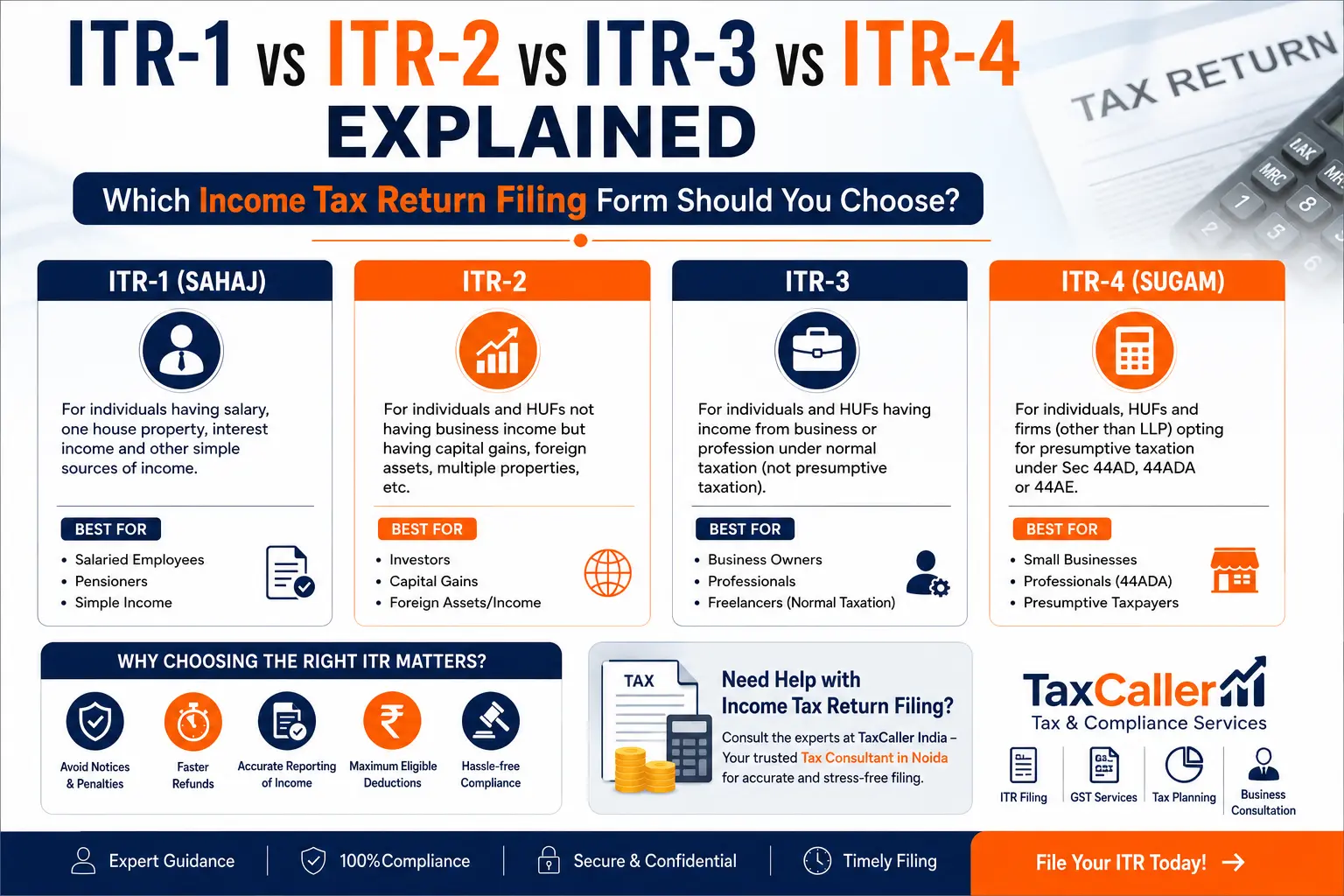
ITR-1 is for eligible salaried individuals with simple income, ITR-2 for those with capital gains or foreign assets (without business income), ITR-3 for business/professional income and ITR-4 for eligible presumptive taxation taxpayers.
ITR-1 vs ITR-2 vs ITR-3 vs ITR-4 Explained
Selecting the appropriate Income Tax Return One of the most important steps in filing your income tax return is filing the form. Filing the wrong ITR form may lead to issues like defective return notices, delayed refunds, or additional compliance requirements. Which is the right form depends on your income sources, residential status and whether you have business or professional income.
If you are not sure which form is applicable to you, then this guide explains the difference between ITR-1, ITR-2, ITR-3 and ITR-4 in simple language. Whether salaried employee, freelancer, business owner, investor or professional, this article will help you identify the right return form.
Why Choosing the Correct ITR Form Matters
Many taxpayers focus only on filing before the due date, but selecting the correct form is equally important. Filing the wrong ITR may result in:
- Defective return notices
- Delay in tax refund
- Additional compliance requests
- Rejection of return in certain cases
- Difficulty in claiming deductions or reporting income correctly
Proper Income Tax Return Filing starts with selecting the correct ITR form.
What is ITR-1 (Sahaj)?
ITR-1 is designed for resident individuals having relatively simple income.
You can file ITR-1 if:
- Total income is up to ₹50 lakh
- Salary or pension income
- Income from one eligible house property
- Interest income and other income
- Agricultural income up to prescribed limits
- Eligible capital gains as permitted under current rules
ITR-1 is generally suitable for:
- Salaried employees
- Pensioners
- Individuals earning interest from savings or fixed deposits
However, ITR-1 cannot be used if you have business income, foreign assets, significant capital gains beyond the permitted limits, or certain other specified situations.
What is ITR-2?
ITR-2 is meant for individuals and HUFs who do not have business or professional income but have more complex income sources.
ITR-2 is generally applicable if you have:
- Salary income
- Multiple house properties
- Capital gains from shares or property
- Foreign assets or foreign income
- Dividend income
- High-value investments
- Income exceeding ITR-1 eligibility
ITR-2 is commonly used by:
- Investors
- Individuals selling property
- Stock market traders (where business treatment is not applicable)
- NRIs (subject to eligibility)
- Individuals with foreign assets
What is ITR-3?
ITR-3 is meant for taxpayers having income from business or profession.
File ITR-3 if you have:
- Proprietorship business
- Professional income
- Freelancing income
- Consultancy income
- Trading business
- Manufacturing business
- Online business
- Business income along with salary or capital gains
Typical users include:
- Chartered Accountants
- Lawyers
- Doctors
- Architects
- Digital consultants
- Software consultants
- Traders
- Agency owners
- Business proprietors
If your income is calculated under normal accounting provisions rather than presumptive taxation, ITR-3 generally applies.
What is ITR-4 (Sugam)?
ITR-4 is a simplified return meant for eligible taxpayers opting for presumptive taxation.
It covers income computed under:
- Section 44AD
- Section 44ADA
- Section 44AE
Suitable for:
- Small businesses
- Freelancers opting for presumptive taxation
- Professionals eligible under Section 44ADA
- Small transport operators
ITR-4 offers a simpler compliance process for eligible taxpayers with turnover and income within prescribed limits.
Quick Comparison: ITR-1 vs ITR-2 vs ITR-3 vs ITR-4
|
ITR Form
|
Suitable For
|
|
ITR-1
|
Salaried individuals with simple income
|
|
ITR-2
|
Salary + Capital Gains + Property + Foreign Income (No Business)
|
|
ITR-3
|
Business owners and professionals under normal taxation
|
|
ITR-4
|
Small businesses and professionals under presumptive taxation
|
| Feature |
ITR-1 |
ITR-2 |
ITR-3 |
ITR-4 |
| Salary |
✅ |
✅ |
✅ |
✅ |
| Business |
❌ |
❌ |
✅ |
✅ |
| Capital Gains |
Limited |
✅ |
✅ |
Limited |
| Foreign Assets |
❌ |
✅ |
✅ |
❌ |
| Presumptive Taxation |
❌ |
❌ |
❌ |
✅ |
Which ITR Form Should Salaried Employees Choose?
Most salaried employees can file:
- ITR-1 (simple salary cases)
- ITR-2 (if capital gains, foreign assets, multiple properties, or other complex income exist)
Which ITR Form Should Freelancers Choose?
Freelancers usually file:
- ITR-3 if maintaining books of accounts
- ITR-4 if opting for presumptive taxation under Section 44ADA
Examples:
- Graphic Designers
- Software Developers
- Digital Marketing Consultants
- Lawyers
- Architects
- Doctors
- Tax Consultants
Which ITR Form Should Business Owners Choose?
Business owners generally file:
- ITR-3 for regular accounting
- ITR-4 for presumptive taxation (if eligible)
Examples include:
- Retail shops
- Traders
- E-commerce sellers
- Manufacturers
- Service providers
Common Mistakes While Selecting an ITR Form
Avoid these mistakes during Income Tax Return Filing:
- Selecting ITR-1 despite having capital gains
- Filing ITR-4 without meeting presumptive taxation conditions
- Ignoring foreign assets
- Reporting business income in the wrong form
- Forgetting professional receipts
- Incorrectly classifying stock market income
Documents Required for Income Tax Return Filing
Keep these documents ready:
- PAN Card
- Aadhaar Card
- Form 16
- AIS
- Form 26AS
- Salary slips
- Bank statements
- Interest certificates
- Capital gain statements
- Business books (if applicable)
- GST records (if applicable)
- Investment proofs
- Home loan certificate
Why Professional Assistance is Important
Every taxpayer is different financially. Salaried employee, freelancer, consultant, investor or business owner need different ITR forms..
Consulting an experienced Tax Consultant in Noida helps ensure:
- Correct ITR selection
- Maximum eligible deductions
- Accurate reporting
- Faster refund processing
- Reduced chances of notices
- Compliance with current tax rules
Why Choose TaxCaller?
TaxCaller provides professional Income Tax Return Filing services for individuals, professionals, startups, and businesses across India.
Our services include:
- ITR-1 Filing
- ITR-2 Filing
- ITR-3 Filing
- ITR-4 Filing
- Tax Planning
- Capital Gain Tax Computation
- Business Taxation
- Freelance Tax Filing
- GST Services
- Income Tax Notice Assistance
Looking for a Trusted Tax Consultant in Noida? Our expert tax professionals can help you select the right ITR form and file your return correctly.
Frequently Asked Questions (FAQs)
Which ITR form is best for salaried employees?
Most of the salaried taxpayers file ITR-1 ITR-2 For those who have capital gains, more than one house property, or foreign assets.
Can freelancers file ITR-1?
No, freelancers generally file ITR-3 or ITR-4 based on whether they choose normal taxation or presumptive taxation.
Which ITR is used for business income?
The business owners generally file ITR-3 or ITR-4 as per their eligibility and mode of taxation.
Can I change my ITR form after filing?
Corrective action depends on the stage of processing and applicable provisions if an incorrect form has been filed. Professional opinion is advised.
Is professional help necessary for Income Tax Return Filing?
If you have business income, capital gains, foreign assets or multiple sources of income, you should seek the help of a qualified Tax Consultant in Noida to make sure you comply accurately.
Which ITR should a salaried person with stock market income file?
If you are a salaried employee and have earned capital gains through shares or mutual funds, then you generally need to file ITR-2. However, if your stock market activity is considered as business income (for instance, frequent trading or intraday trading), ITR-3 may apply. Make sure Income Tax Return Filing is correct and to avoid notices by selecting the correct form.
Which ITR is for freelancers?
Freelancers usually file ITR-3 if they have regular books of accounts and declare actual profits. If they choose the presumptive taxation scheme under Section 44ADA and meet the eligibility conditions, they can file ITR-4 (Sugam). The form you’ll use depends on what kind of income you have and how you want to be taxed.
Which ITR is for doctors?
Doctors with professional income generally have to file ITR-3. However, such individuals can file ITR-4 if they opt for the presumptive taxation scheme under Section 44ADA and meet the prescribed conditions. A qualified Tax Consultant in Noida can help you decide the correct ITR form as per your income.
Which ITR is for advocates?
Usually, advocates and legal professionals file ITR-3 for professional income. If they are eligible and choose Section 44ADA (Presumptive Taxation), then they can file ITR-4. Choosing the right return form is very important for correct Income Tax Return filing.
Which ITR should an NRI file?
ITR-1 cannot be filed by Non-Resident Indians (NRIs). They generally file ITR-2 (if they do not have business or professional income) or ITR-3 (if they have business or professional income taxable in India) depending on their sources of income. The form to be used depends on the nature of income earned during the financial year.
What happens if I file the wrong ITR?
Filing wrong ITR form may result in your return being considered as defective and a notice from the Income Tax Department. It may also delay your refund, require you to file an amended return, and impose additional compliance burdens. Know the correct ITR form before filing your Income Tax Return or seek professional assistance from an experienced Tax Consultant in Noida.
Conclusion
Choosing the right ITR form is the basis of correct Income Tax Return Filing. Which ITR do you need – ITR-1, ITR-2, ITR-3 or ITR-4? It depends on your sources of income and tax profile. To avoid notices, delays and compliance problems, and to help ensure that your return is processed smoothly, file the correct form. Before filing, review your income thoroughly or seek the advice of an experienced Tax Consultant in Noida to ensure you select the correct form and stay fully compliant with the Income Tax Act.
 4.9 Google Rating
 4.4 Rated Excellent Trustpilot