Partnership firm registration with a tax-ready deed, correct stamp duty, Form 1 filing with your state's Registrar of Firms, and the firm's PAN, TAN and GST handled by our tax experts.
Starting from · ₹1,999 Partnership Firm Registration Basic plan
STARTING FROM₹1,999
FEE TOLD UPFRONTFree first call
!New company?File INC-20A within 180 days of incorporation
Since 2018Trusted Experience
980+Experts Connected
220+Cities Served
1164+Agents Available
12,650+Founders Trusted
S
Srishti Magoo
★★★★★
Excellent experience with TaxCaller for filing my &
my family members ITR returns. The entire process was
smooth, quick and hassle-free. They are professional,
knowledgeable and guided me through every step with patience.
O
obeid sait
★★★★★
The team has handled my taxes for the past three years,
and it's been a wonderful, hassle-free experience.
Thank you for your consistently quick and efficient service.
P
Pushkar
★★★★★
They are among the best in their field. Their work culture
is highly professional, and their client service is smooth
and reliable. They can confidently be relied on to get the job done.
P
Prasad Sheth
★★★★★
Excellent experience with TaxCaller! The ITR filing
process was smooth, quick, and completely hassle-free.
The CA was knowledgeable, responsive, and explained everything clearly.
A
Apoorv Bansal
★★★★★
Excellent service for ITR filing. The team was highly
professional, responsive, and guided me through the entire
process smoothly. My return was filed accurately and on time.
A
Abhishek Kumar
★★★★★
I was searching for a good CA firm in Ghaziabad and found
TaxCaller. The experience was excellent from start to finish.
The team is responsive, transparent, and genuinely helpful.
U
uma pandey
★★★★★
Great service! TaxCaller India made the entire ITR filing
process quick, smooth, and hassle-free. They answered all
my queries patiently and ensured maximum accuracy.
T
tanu mittal
★★★★★
Excellent job! We've been connected for many years,
and your success truly makes me happy. You are an
incredibly intelligent person. Keep shining, keep growing.
B
Bhanu Pratap Maurya
★★★★★
I am filing my ITR since past 3 years with Abhinav and
Firm is known as TaxCaller and they are professional
interms of ITR rules. They will explain and tell you all
the information.
A
ashish Sharma
★★★★★
I am providing my honest reviews:
No.1 service ...
A
AARYAN GROUP
★★★★★
Honestly, finding a good CA firm in Ghaziabad was
confusing, but TaxCaller India made it simple.
I contacted them for GST work and the experience was smooth.
N
News Speaks
★★★★★
If you're looking for a reliable CA firm in Ghaziabad,
TaxCaller India is a great choice. They provide complete
taxation and compliance solutions including GST.
A
Anshul Chaprana
★★★★★
Got my GST registration done through TaxCaller CA firm.
Process was quite smooth, they guided properly on documents
and didn't waste time. Overall good experience.
How we work
Online · Call · WhatsApp
Quick answer
Partnership firm registration means entering your firm with the state Registrar of Firms under section 58 of the Indian Partnership Act, 1932. You need a stamped partnership deed, Form 1 signed by all partners, partner KYC and address proof. It usually takes 2 to 3 weeks. Government fees are extra; TaxCaller's own fee starts at ₹1,999 + GST.
Reviewed by Abhinay Rai · Updated 21 Nov 2026
Pick a plan that fits
Basic
Partners who need the firm registered with the Registrar of Firms
₹1,999+ GST
+ Govt. fee and stamp duty at actual
Pay now (49%)₹980+ GSTAfter the registration certificate₹1,019+ GST
Handled by a TaxCaller Expert Company Registration Expert
Guidance on partner salary limits under section 40(b) and TDS on partner payments
One deed amendment or partner change intimation in the first year
Government fees and taxes are extra where applicable. Our expert confirms the final amount on the first call. No hidden charges.
About Partnership Firm Registration
Partnership firm registration gives your business a place in your state's Register of Firms under the Indian Partnership Act, 1932. It suits two or more people who want to run a business together with low cost and simple rules. Registration is optional under the central Act, but an unregistered firm cannot sue to recover its dues. That one rule, in section 69, is why most firms register.
The process has three parts: a well-drafted partnership deed, the right stamp duty for your state, and the Form 1 statement filed with the Registrar of Firms. After that come the firm's PAN, TAN, GST registration and a current bank account. This page explains each step, the government fees in different states, how firms are taxed, and what changed in 2026.
TaxCaller has helped small businesses with registrations and tax filings since 2018. Our tax experts draft your deed, prepare Form 1, file it in your state's system and follow up until the certificate is issued. The work is done online, so partners in any city can register without visiting our office.
Complete guide
Choose a topic to open it. Every answer gives the rule or section it comes from.
01 Topic 1 of 20
Partnership Firm Registration Explained: Meaning and Legal Basis
A partnership is a business owned by two or more people who agree to share its profits. Section 4 of the Indian Partnership Act, 1932 defines it as the relation between persons who agree to share the profits of a business carried on by all of them, or by any of them acting for all. Together the partners are called a "firm". The name they trade under is the "firm name".
Partnership firm registration is the act of entering your firm in the Register of Firms kept by the Registrar of Firms of your state. You file a statement under section 58 (usually called Form 1, though the name varies by state) with the prescribed fee. Once the Registrar is satisfied, section 59 says the statement is recorded in the register and filed. You then receive a certificate of registration with a firm registration number.
A firm is not a company. It does not register with the Ministry of Corporate Affairs and it has no CIN. It is a state subject. Each state appoints its own Registrar under section 57 and sets its own fees and forms under section 71. That is why the process in Uttar Pradesh looks different from the process in Delhi, Goa or Madhya Pradesh.
Key features of a partnership firm
Formed by agreement: section 5 says partnership arises from a contract, not from status. Family members become partners only if they sign up as partners.
At least two partners: a partnership needs two or more persons. The upper limit is 50 (see below).
Shared profits: profits and losses are shared in the ratio fixed in the deed. If the deed is silent, section 13(b) says they are shared equally.
Mutual agency: each partner can bind the firm for acts done in the normal course of business.
Unlimited liability: under section 25, every partner is liable jointly and also severally for all acts of the firm done while he or she is a partner.
No separate legal person: the firm and the partners are one in law. The firm is still a separate "person" for income tax and GST.
You can read the full Act on the India Code portal. Chapter VII (sections 56 to 71) deals with registration.
Is Registration Compulsory? Section 69 and the Cost of Staying Unregistered
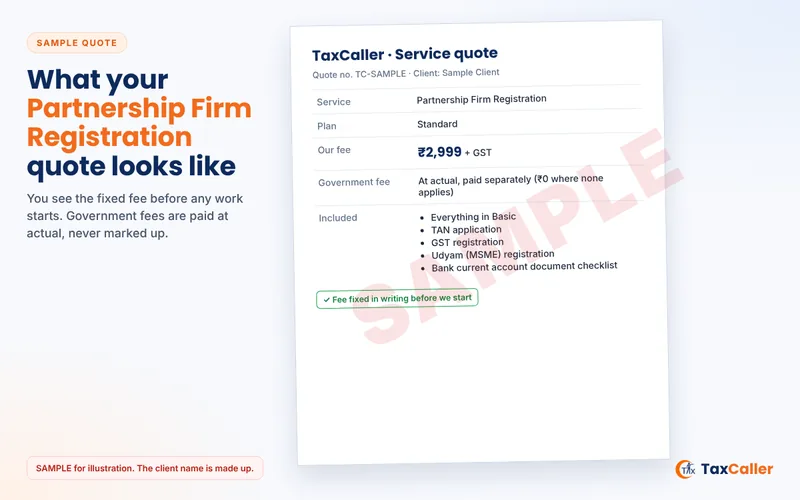
Partnership Firm Registration: SAMPLE quote, for illustration only
Under the central Act, registration is optional. Section 58 says a firm may be registered "at any time". A firm that never registers is still legal. It can trade, get a PAN, open some bank accounts and pay tax. But section 69 takes away important rights. In practice, most firms that deal with customers, suppliers, banks or government buyers choose to register.
What section 69 says
Section 69(1): a partner cannot sue the firm or a fellow partner to enforce a right under the partnership contract or the Act, unless the firm is registered and the person suing is shown in the Register of Firms as a partner.
Section 69(2): the firm cannot sue an outsider (a customer, supplier or landlord) to enforce a contract, unless the firm is registered and the partners suing are shown in the register.
Section 69(3): the same bar applies to a claim of set-off or any other proceeding to enforce a contract right.
What an unregistered firm can still do
A partner can sue for dissolution of the firm, for accounts of a dissolved firm, or to realise the property of a dissolved firm.
An official assignee or receiver can still realise the property of an insolvent partner.
Outsiders can always sue the unregistered firm and its partners. The bar works only one way.
Section 69(4) leaves out firms with no place of business in the territories covered, and suits or set-off claims of a value up to ₹100.
A simple example
Ravi and Meena run an unregistered trading firm in Ghaziabad. A buyer owes them ₹4 lakh and refuses to pay. Because the firm is unregistered, section 69(2) stops the firm from filing a recovery suit. They would first have to register, and courts have held that registration after filing the suit does not cure the defect. The buyer, on the other hand, can sue them at any time.
States where registration is effectively required
Some states have amended the Act. Maharashtra, for example, requires a firm to apply within one year of formation, makes reporting of changes compulsory within 90 days, and adds delay charges under its section 69A. Always check your state's version before you decide to stay unregistered.
Shadab Company Registration Expert
Have a question on this topic? Ask Shadab on a free call.
This page covers only partnership firms. If you are still choosing a structure, our company registration guide compares every option side by side. Here is a short test for the partnership route.
A partnership firm usually suits you if
Two or more people, often family members or friends, want to start trading quickly at low cost.
The business is local or regional: a shop, trading house, contractor, small manufacturer or service agency.
You do not plan to raise equity from investors.
The partners trust each other and accept personal liability for business debts.
You want low ongoing compliance: no board meetings, no annual MCA filings.
Look at other options if
You want to protect personal assets. An LLP registration gives partners limited liability.
You plan to raise funds, issue shares or offer ESOPs. A private limited company is built for that.
Who Can Be a Partner, How Many, and Types of Partnership
Who can be a partner
Individuals: any adult of sound mind who is not disqualified by law can be a partner.
Minors: a minor cannot be a full partner. Under section 30, a minor can be admitted only to the benefits of partnership, with the consent of all partners. Within six months of turning 18 (or of learning of the admission, if later), the minor can give public notice of the choice to become a partner or not. If no notice is given, he or she becomes a partner.
HUF through its Karta: a Karta can join in a representative capacity. Section 5 makes clear that HUF members are not partners merely because of family status.
Companies and LLPs: a company or LLP can become a partner through an authorised representative, if its own documents allow it.
NRIs and foreign nationals: foreign investment in a partnership firm is restricted under FEMA rules. NRIs can usually invest on a non-repatriation basis, with conditions. Take advice before adding a non-resident partner.
Minimum and maximum number of partners
A firm needs at least two partners. The maximum is 50. Section 464 of the Companies Act, 2013 caps the number, and Rule 10 of the Companies (Miscellaneous) Rules, 2014 sets it at 50. A larger group must register as a company or an LLP.
Types of partnership
Type
Section
What it means
Partnership at will
Section 7
No fixed term in the deed. Any partner can end it by written notice under section 43.
Particular partnership
Section 8
Formed for one venture or project, such as a single construction contract.
Fixed-term partnership
Section 42(a)
Formed for a set period. It ends when the term ends, unless the partners continue.
Types of partners
Working (active) partner: takes part in running the business. Only working partners can get tax-deductible remuneration.
Sleeping partner: invests capital and shares profit but does not manage. Still fully liable to outsiders.
Partner by holding out: a person who lets others believe he or she is a partner. Under section 28, that person is liable to anyone who gave credit to the firm on that belief, even without being a real partner.
Nominal partner: lends name and credit without capital or profit share. Still liable to outsiders who rely on the name.
The deed should say clearly who is a working partner. This matters for income tax, as you will see below.
Right to sue: the firm can file suits to recover dues and enforce contracts, and partners can enforce their rights against each other.
Proof of existence: under section 68, entries in the Register of Firms are conclusive proof against the partners who signed them. A certified copy proves the firm's registration.
Bank accounts and loans: banks ask for the registration certificate along with the deed and the firm's PAN when opening a current account or giving credit.
Tenders and contracts: government departments and large buyers often ask for a registered firm.
Clear public record: anyone can inspect the register under section 66 for a fee, which builds trust with lenders and suppliers.
Protection when partners leave: a notice under section 63, plus public notice under section 72, limits an outgoing partner's liability for later acts of the firm.
Easy conversion: a registered firm has the records needed to convert into an LLP under the LLP Act, 2008.
Low cost and light compliance: registration is a one-time step. There is no annual return to the Registrar of Firms.
Shreya Company Registration Expert
Have a question on this topic? Ask Shreya on a free call.
The partnership deed is the written agreement between the partners. Section 11 lets partners decide their rights and duties by contract. The deed is the heart of your registration. The Registrar reads it, the bank reads it, and the income tax officer reads it.
Clauses every deed should have
Name and address of the firm, and of every partner
Nature of business and the date the partnership starts
Duration: at will, for a project, or for a fixed term
Capital each partner brings, and how more capital will be added
Profit and loss sharing ratio
Interest on capital and on partners' loans (section 13(d) gives 6% on advances beyond capital if the deed is silent)
Which partners are working partners, and the method to work out their remuneration
Powers and duties of each partner, banking authority and signing limits
Rules for admission, retirement, expulsion and death of a partner
Accounts, books, audit and the financial year
Dispute resolution, such as arbitration
Dissolution and settlement of accounts
A deed that leaves out the remuneration method can cost you money later. Income tax allows a deduction for partner salary only if the deed authorises it and fixes the amount or the method.
Rules for choosing the firm name
Section 58(3) bars words such as Crown, Emperor, Empress, Empire, Imperial, King, Queen and Royal, and words that suggest government approval, unless the state government consents in writing.
Do not pick a name that is the same as, or very close to, another firm or a registered trademark. It can lead to an objection or a trademark dispute.
Run a quick check on the trademark registry before you print stationery. Our trademark registration team can protect the name once the firm is set up.
A partnership deed is an "instrument of partnership". Stamp duty on it is fixed by the stamp law of the state where it is signed. In the central Indian Stamp Act, 1899 this is Article 46 of Schedule I. Many states have their own schedule or their own Stamp Act. The duty is either a flat amount or a percentage of capital with a cap.
State
Stamp duty on partnership deed
Where to confirm
Goa
₹500 if no capital is stated; if capital is stated, ₹500 for every ₹50,000, up to ₹5,000
Goa Investment Promotion Board service sheet for firm registration (official)
Uttar Pradesh
Commonly charged at ₹750 for an instrument of partnership
IGRS Uttar Pradesh fee page and e-stamp calculator
Delhi
Commonly charged at 1% of capital, minimum ₹200 and maximum ₹5,000
Delhi Revenue Department, Schedule I link and e-stamp calculator
Maharashtra
Commonly charged at ₹500 if capital is up to ₹50,000; above that, 1% of capital, up to ₹15,000
Maharashtra Stamp Act schedule (IGR Maharashtra)
Gujarat
Commonly charged at ₹1 for every ₹100 of capital, up to ₹10,000
Gujarat Stamp Act, 1958 schedule
Goa's rate comes from the state's official service sheet. The other rows are rates widely reported for these states. Stamp rates change by state notification, so we check the current figure on the state's official portal on the day you buy the e-stamp. For Uttar Pradesh, see the IGRS UP fee details page. For Delhi, see the Delhi Revenue Department page, which links the stamp schedule and calculator.
How the deed is executed
Buy e-stamp paper (or franking) of the correct value in the state where the deed is signed.
Print the final deed on it, or attach the e-stamp certificate as the first page.
All partners sign each page, with two witnesses.
Notarise the deed if your state's Registrar asks for it. Most do.
Keep the original safe. Scan it in colour for the online filing.
A deed with short stamp duty is not admissible as evidence until the deficit and penalty are paid. Paying the right duty at the start is cheaper. If a partner brings land or a building into the firm as capital, take advice on stamp duty and on registering the deed with the Sub-Registrar.
Partnership Firm Registration Process: How TaxCaller Files It
Partnership Firm Registration: how the work moves, step by step
The work is done online with you. You do not need to visit our offices unless you want to. Here is how a typical file moves.
Free first call: our expert checks that a partnership suits you, notes the partners, capital and business, and tells you the state's stamp duty and registration fee.
Name check: we screen your proposed firm names against section 58(3), your state's list of restricted words and the trademark registry.
Deed drafting: we draft the deed with capital, profit ratio, working partners, remuneration method, interest, banking powers and exit rules. You review it and ask for changes.
Stamp and sign: you buy the e-stamp of the right value (we tell you the amount), print the deed, and all partners sign before witnesses and a notary.
Firm PAN: we apply for the firm's PAN, using the deed as proof. A firm can get PAN before registration.
Form 1 filing: we prepare the section 58 statement with the firm name, principal place of business, other places, each partner's name, address and date of joining, and the duration. We file it with the Registrar of Firms online, or help you submit it where the state still takes paper.
Fee and follow-up: you pay the state registration fee directly to the government. We track the file and reply to any objection raised by the Registrar.
Certificate: once the Registrar records the entry under section 59, you get the certificate of registration. We check every detail on it.
Next steps: we help with TAN, GST, Udyam and the bank's current account checklist, based on the plan you choose.
You can reach our expert on call throughout. You see each document before it is filed.
Each state runs its own system. Some are fully online with e-sign. Others still need a physical visit or a hard copy. Here are a few examples from official sources.
State
Who registers
How it works
Goa
Department of Registration, Goa
Online only on the Goa partnership portal. Registration fee ₹1,000. Notified service time is 7 days under the state's public services law.
Madhya Pradesh
Assistant Registrar, Firms and Societies
Online on the MP Firms and Societies portal. One-time registration fee ₹635. Review in about 4 days, final review of signed papers in about 3 days.
Uttarakhand
Registrar of Firms
Online filing with digital signature, a notarised affidavit on stamp paper and online fee payment. Digitally certified copies under section 67.
Uttar Pradesh
Registrar of Firms, Societies and Chits, Uttar Pradesh
Applications are reported to start online on the UP Firms, Societies and Chits portal. The department is also listed on the Nivesh Mitra single window. Apply with the stamped deed, the section 58 statement and partner KYC. Some districts still ask for signed originals. Fee as per the state rules.
Tamil Nadu
Registrar of Firms
Reported: Form 1 is filed and the fee paid online on TNREGINET, the Registration Department portal. The signed documents are then submitted at the registrar's office.
Assam
Registrar of Firms, Finance Department
Online through Sewa Setu. Application fee ₹5. Stipulated time 10 working days for a complete application. Form 1 must be witnessed by a Judicial Magistrate or Chartered Accountant.
Chandigarh
Registrar of Firms
Service listed on the district website with online apply and track links. Listed fee ₹3.
West Bengal
Registrar of Firms, Societies and Non-Trading Corporations
Online form, online payment, status tracking and an online final certificate.
Jammu and Kashmir
Applied through the J&K Single Window portal
Online form with partner details. The user manual asks for the deed and rent deed registered before the Sub-Registrar.
Delhi
Registrar of Firms appointed under section 57
Forms and fees are set by the rules Delhi makes under section 71. We confirm the current form before filing.
Maharashtra
Registrar of Firms
Apply within one year of formation. Changes must be reported within 90 days. Registered firms add "(Registered)" after the name.
The registration fee is small in most states, but it is set by each state under section 71 and can change. We confirm the current fee for your state on the first call and show it separately from our fee.
Checking a firm's registration
Section 66 lets anyone inspect the Register of Firms for a fee. Section 67 lets you get a certified copy of an entry. Some states, such as Madhya Pradesh and Uttarakhand, let you download the certificate or a certified copy online.
Most firms are registered within 2 to 3 weeks of the first call. Online states such as Goa (7 days service time) are usually faster. The Registrar's timing is outside our control, so we do not promise a fixed date. We give you a realistic estimate for your state at the start.
Abhinay Rai Company Registration Expert
Have a question on this topic? Ask Abhinay on a free call.
Your total cost has two parts. Government fees go to the state. Our professional fee pays for the work we do. We always show them separately.
Government fees and statutory costs (paid at actual)
Item
Who sets it
Example
Stamp duty on the partnership deed
State Stamp Act
Goa: ₹500 for every ₹50,000 of capital, up to ₹5,000
Registration fee for Form 1
State rules under section 71
Goa ₹1,000; Madhya Pradesh ₹635
Notary charges
Local notary
Varies by city
PAN and TAN application charges
Income Tax Department through its agencies
Small fixed charge, shown on the form
GST registration
GST law
No government fee
TaxCaller's professional fee
TaxCaller's fee starts at ₹1,999 + GST. Government fees (stamp duty, the state registration fee, notary and PAN/TAN charges) are paid separately at actual. The fee depends on the plan you pick, the number of partners and your state. Our expert confirms the exact amount on the first call, before you pay anything.
What is not included
Travel or courier, if your state needs a physical submission
Court work, disputes or recovery suits
Monthly accounting, GST returns and ITR filing, unless your plan says so
There are no hidden add-ons. If something extra comes up, such as a Registrar objection that needs a fresh deed, we tell you the cost first.
Every firm that files an income tax return needs its own PAN. The application uses the partnership deed or the registration certificate as proof of the firm's existence. A partner signs as the authorised person. You can get PAN even before the firm is registered.
TAN
If the firm will deduct tax at source, it needs a TAN, applied for on Form 135 (Form 49B before April 2026). A firm that pays rent, contractors, professionals, or salary and interest to partners above the limits will usually need one. See our TDS return filing page for the quarterly returns that follow.
GST registration
A firm needs GST registration once its aggregate turnover crosses the threshold. The limit is generally ₹40 lakh for suppliers of goods only and ₹20 lakh for services, with lower limits in some special category states. Some businesses must register regardless of turnover, such as those making inter-state taxable supplies of goods or selling through e-commerce operators. The application on the GST portal lists every partner and an authorised signatory. Our GST registration service handles this end to end.
Current bank account
Banks follow the RBI's KYC Master Direction. For a partnership firm they usually ask for the registration certificate, the partnership deed, the firm's PAN, KYC of the partners and authorised signatories, and proof of the business address. The account must be in the firm's name, and the deed should say who can operate it.
Other registrations you may need
Udyam registration for MSME benefits, through our MSME registration service
Shops and Establishments registration under your state's law
For income tax, a firm is a separate person even though it is not a separate legal entity. It files its own return and pays tax at a flat rate. The figures below are for AY 2026-27 (FY 2025-26), as given on the Income Tax Department's partnership firm and LLP help page.
Item
Rate or rule
Income tax
30% of total income
Surcharge
12% of tax, only if taxable income exceeds ₹1 crore
Health and Education Cess
4% of tax plus surcharge
Alternative Minimum Tax (AMT)
18.5% of adjusted total income, if normal tax is lower and certain deductions are claimed
Return form
ITR-5; or ITR-4 for a resident firm (not LLP) with income up to ₹50 lakh using presumptive taxation
There is no basic exemption limit for a firm. Tax applies from the first rupee of profit.
Interest and remuneration to partners: section 40(b)
Under section 40(b) of the Income-tax Act, 1961, a firm can deduct interest and salary paid to partners only within limits:
Interest on capital: allowed up to 12% simple interest a year, and only if the deed authorises it.
Remuneration: allowed only to working partners who are individuals, only if the deed authorises it, and only for the period after the deed.
Limit on remuneration (from AY 2025-26): on the first ₹6 lakh of book profit, or on a loss, ₹3 lakh or 90% of book profit, whichever is more; on the balance of book profit, 60%.
Example: a firm's book profit is ₹10 lakh. The limit is 90% of ₹6 lakh (₹5.4 lakh) plus 60% of ₹4 lakh (₹2.4 lakh). So up to ₹7.8 lakh of remuneration can be deducted, if the deed allows it. Anything above the limit is taxed in the firm's hands.
From tax year 2026-27, the Income-tax Act, 2025 governs these deductions under its own renumbered provisions. We apply the provision in force for your tax year when we prepare the accounts and return.
How partners are taxed
A partner's share of the firm's profit is exempt in the partner's hands under section 10(2A) of the 1961 Act, because the firm has already paid tax on it.
Interest and remuneration received from the firm, to the extent allowed to the firm, are taxed in the partner's hands as business income. Partners usually file ITR-3.
From 1 April 2025, a firm must deduct 10% TDS on salary, remuneration, commission, bonus or interest paid to a partner when the total crosses ₹20,000 (section 194T of the 1961 Act). Under the 2025 Act this is Sl. No. 7 of the table in section 393(3).
Presumptive tax option
A small resident firm (not an LLP) can declare income under section 44AD at 8% of turnover, or 6% for digital receipts, if turnover is within the limit. Remuneration and interest to partners are then not deducted separately. Our income tax filing team will compare both methods with you.
Shadab Company Registration Expert
Have a question on this topic? Ask Shadab on a free call.
A registered firm has no annual return to the Registrar of Firms. Its yearly work is mainly tax compliance, plus updating the register when something changes.
Changes you report to the Registrar
Change
Section
Change of firm name or principal place of business
Section 60
Opening or closing a branch
Section 61
Change in a partner's name or permanent address
Section 62
Partner joins, retires or dies; firm dissolved; minor elects on turning 18
Section 63
Correction of a mistake in the register
Section 64
Under the central Act these intimations are optional, but skipping them is risky. An outgoing partner stays liable to outsiders for later acts of the firm until public notice is given. Section 72 requires that notice to go to the Registrar and be published in the Official Gazette and a local language newspaper. In Maharashtra, reporting changes within 90 days is compulsory.
Yearly tax and accounts work
Books of account: keep proper books once turnover or income crosses the limits. Our accounting and bookkeeping service can handle this.
Tax audit: needed if turnover exceeds ₹1 crore, or ₹10 crore if cash receipts and payments are each within 5%.
Income tax return: ITR-5 every year, even with a loss or nil income.
Advance tax: in four instalments if tax for the year is ₹10,000 or more.
GST returns: monthly or quarterly, if registered. See GST return filing.
TDS returns: quarterly, if the firm deducts TDS, including TDS on partner payments.
Return due dates for AY 2026-27
Firms not needing audit: 31 August 2026 (Finance Act, 2026 added this date).
Firms needing audit: 31 October 2026, extended to 21 November 2026 by CBDT Circular No. 07/2026. The audit report date moved to 21 October 2026.
Cannot sue third parties on contracts; partners cannot sue each other or the firm for contract rights
False or incomplete particulars in Form 1 or a later notice
Section 70, Partnership Act
Imprisonment up to 3 months, or fine, or both (Maharashtra: up to 1 year, with a minimum fine of ₹1,000 unless the court records reasons)
Late registration or late reporting in Maharashtra
Section 69A (Maharashtra amendment)
Delay charges
Partner retires without public notice
Sections 32 and 72, Partnership Act
Retiring partner stays liable to outsiders for later acts of the firm
Late income tax return
Section 234F (1961 Act); section 428 (2025 Act, from tax year 2026-27)
Late fee up to ₹5,000 (₹1,000 if total income is up to ₹5 lakh), plus interest on tax due
Late tax audit report (from tax year 2026-27)
Section 428(c), 2025 Act
Fee of ₹75,000 if up to one month late, ₹1,50,000 after that
TDS on partner payments not deducted or deposited
Section 194T (1961); section 393 (2025)
Interest, disallowance of part of the expense and penalty
Because partners have unlimited liability, a tax or loan default of the firm can be recovered from the partners' personal assets. Keep compliance current to avoid that risk.
The Partnership Act itself was not rewritten in 2026. The big changes came from tax law. Here is what matters for a firm this year.
Income-tax Act, 2025 in force from 1 April 2026. It replaces the 1961 Act for tax years starting on or after 1 April 2026. The "tax year" replaces the old "previous year" and "assessment year". Income of FY 2025-26 is still taxed and returned under the 1961 Act in 2026.
New TDS section for partner payments. Partner salary, commission, bonus and interest now sit in the table of section 393(3) (Sl. No. 7): 10% TDS once payments to a partner exceed ₹20,000. This replaced section 194T, which itself applied only from 1 April 2025.
New tax audit form. From tax year 2026-27, tax audit falls under section 63 of the 2025 Act, with Form 26 under Rule 47 of the Income-tax Rules, 2026 replacing Forms 3CA, 3CB and 3CD.
New 31 August due date. The Finance Act, 2026 gave non-audit business cases, including firms and their partners, a 31 August due date. For AY 2026-27 that is 31 August 2026.
Audit-case due date extended. CBDT Circular No. 07/2026 dated 28 September 2026 moved the return due date for audit cases from 31 October to 21 November 2026, and the audit report date to 21 October 2026.
Late fee renumbered. From tax year 2026-27 the late filing fee moves from section 234F to section 428 of the 2025 Act.
State registration rules can change at any time by notification. We check your state's portal for the current form and fee before every filing.
Many firms move to an LLP once they grow, to get limited liability and a separate legal identity. Section 55 and the Second Schedule of the Limited Liability Partnership Act, 2008 allow this.
How conversion works
All partners of the firm must become the partners of the LLP, and no one else.
The LLP is incorporated on the MCA portal with the conversion form (Form 17) filed alongside the incorporation form.
The firm's assets, liabilities, contracts and pending cases move to the LLP. The firm is then treated as dissolved.
Within 15 days of registration, the LLP must inform the Registrar of Firms about the conversion (Form 14).
The LLP gets a new PAN. GST, bank accounts and licences must be moved to the LLP's name.
Points to check first
Consent of all partners and a clear statement of assets and liabilities
Creditor and lender approvals, where loan terms require them
Income tax effects, especially if assets are revalued or partners' capital changes
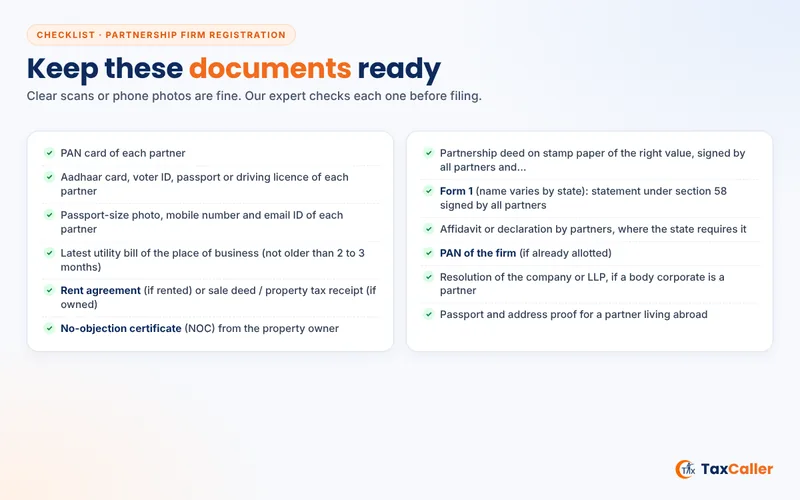
Aadhaar card, voter ID, passport or driving licence of each partner
Passport-size photo, mobile number and email ID of each partner
Latest utility bill of the place of business (not older than 2 to 3 months)
Rent agreement (if rented) or sale deed / property tax receipt (if owned)
No-objection certificate (NOC) from the property owner
Partnership deed on stamp paper of the right value, signed by all partners and notarised
Form 1 (name varies by state): statement under section 58 signed by all partners
Affidavit or declaration by partners, where the state requires it
PAN of the firm (if already allotted)
Resolution of the company or LLP, if a body corporate is a partner
Passport and address proof for a partner living abroad
Why TaxCaller
Real experts, not a call centre
Your work is handled by experienced professionals who explain every step, check your documents and keep you updated.
Registered company
TaxCaller is run by TaxCaller India LLP (LLPIN AAQ-7388), serving clients since 2018.
Fee told upfront
You know the complete fee, our professional fee and the government fee, before any work starts. No hidden charges.
Support after the work
Notices, renewals, returns and compliance reminders: we stay with your business after the registration is done.
Reviewed By
Expert for this topic Partnership Firm Registration
Abhinay Rai
Advocate
Abhinay Rai is a Advocate specialising in Partnership Firm Registration. The process, documents, timelines and fees on this page are checked against the current rules and government portals, and updated whenever the law, forms or fees change.
Partnership Firm Registration: your questions answered
Is partnership firm registration mandatory in India?
No. Under the Indian Partnership Act, 1932, registration is optional, and an unregistered firm is still legal. But section 69 stops an unregistered firm from suing outsiders on contracts, and stops partners from suing each other or the firm. Some states, such as Maharashtra, have amended the Act to require registration within a set time.
How many partners are needed to start a partnership firm?
You need at least two partners. The maximum is 50, under section 464 of the Companies Act, 2013 read with Rule 10 of the Companies (Miscellaneous) Rules, 2014. Partners can be individuals, and a company or LLP can join through a representative. A minor can only be admitted to the benefits of partnership, not as a full partner.
How much does it cost to register a partnership firm?
The cost has two parts. Government costs are stamp duty on the deed, the state registration fee, notary charges and PAN charges, and they differ by state. For example, Goa charges ₹1,000 as registration fee and Madhya Pradesh ₹635. TaxCaller's professional fee is separate, plus GST, and our expert confirms your total on the first call.
How long does partnership firm registration take?
Most firms are registered within two to three weeks. Deed drafting, stamping and signing take about three to five working days. The Registrar of Firms then usually takes about 7 to 15 working days, depending on the state. Online states are faster. Goa, for example, has a notified service time of 7 days.
What is Form 1 for partnership registration?
Form 1 is the usual name for the statement under section 58 of the Partnership Act, though the name varies by state. It gives the firm name, principal place of business, other places of business, each partner's name, address and joining date, and the firm's duration. Every partner, or an authorised agent, must sign and verify it.
Can a partnership firm get a PAN and bank account without registration?
Yes, a firm can apply for PAN using the notarised partnership deed as proof of its existence, even before registration. Some banks will open a current account on the deed and PAN alone. Many banks, though, also ask for the registration certificate under their KYC policy. Registering first avoids delays at the bank and with lenders.
What is the income tax rate for a partnership firm?
For AY 2026-27, a partnership firm pays income tax at 30% of total income. A 12% surcharge applies only if taxable income exceeds ₹1 crore, and 4% Health and Education Cess applies on top. There is no basic exemption limit. Interest and salary to partners are deductible only within the limits of section 40(b).
How much salary can partners take from the firm?
Only working partners named in the deed can get tax-deductible remuneration. From AY 2025-26, the limit on the first ₹6 lakh of book profit, or on a loss, is ₹3 lakh or 90% of book profit, whichever is more. On the remaining book profit, the limit is 60%. Interest on capital is capped at 12% a year.
Is TDS deducted on payments to partners?
Yes. From 1 April 2025, a firm must deduct 10% TDS on salary, remuneration, commission, bonus or interest paid to a partner once the total crosses ₹20,000, under section 194T. Under the Income-tax Act, 2025, this rule now sits in the table of section 393(3). The firm needs a TAN and files quarterly TDS returns.
Does a partnership firm need GST registration?
Only if it crosses the GST threshold or falls in a compulsory category. The limit is generally ₹40 lakh turnover for goods and ₹20 lakh for services, lower in some special category states. Inter-state suppliers of goods and e-commerce sellers usually must register regardless. GST registration has no government fee, and the application lists every partner.
What should a partnership deed contain?
A good deed covers the firm name and address, partners' details, nature of business, start date and duration, capital, profit sharing ratio, interest on capital, names of working partners and their remuneration method, banking powers, admission and retirement rules, accounts, dispute resolution and dissolution. Missing salary or interest clauses can cost the firm its tax deduction.
Can a partnership firm be converted into an LLP?
Yes. Section 55 and the Second Schedule of the LLP Act, 2008 allow a firm to convert into an LLP. All partners of the firm must become the LLP's partners. The firm's assets, liabilities and contracts move to the LLP, and the LLP informs the Registrar of Firms within 15 days. Check the tax effects before converting.
What happens if a partner leaves or a new partner joins?
Amend the partnership deed with a fresh agreement and notify the Registrar of Firms under section 63. When a partner retires, also give public notice under section 72 in the Official Gazette and a local language newspaper. Without that notice, the retiring partner can stay liable to outsiders for the firm's later acts. Update PAN, GST and bank records too.
What are the types of partnership in India?
The Partnership Act names three types by duration. A partnership at will (section 7) has no fixed term and any partner can end it by notice. A particular partnership (section 8) is for one venture. A fixed-term partnership ends when its term ends. Firms are also grouped as registered or unregistered, which decides the right to sue.
How do I register a partnership firm in Uttar Pradesh?
In Uttar Pradesh, firms register with the Registrar of Firms, Societies and Chits through its online portal. You file the Form 1 statement under section 58 with the stamped and signed deed, partner KYC and office proof, then pay the state fee. Businesses in Noida and Ghaziabad follow the same online route. We confirm the current fee first.