Company Registration Made Hassle-Free with TaxCaller

Get your company registration in India completed quickly

Cost-Effective Pricing

Trusted By

23 Lakh++ businesses nationwide
Your partner for company compliance

Expert Help

Expert CA & GST Support Across India

Please Call 8750070081, in case of any issues

Welcome to TaxCaller 🎉

Thank you for contacting us.

Your request has been successfully received and assigned to a dedicated expert.

📞 You will receive a callback shortly with the best solution for your requirement.

About Company Registration

Company registration in India is the process of legally setting up a business under government laws. It gives your business a recognised identity and allows you to operate in an organised and compliant manner.

Overview

Company registration in India is the first formal step to start a business legally. It creates a structured identity for your business and allows it to operate under government regulations. Once registered, a company can open a bank account, enter contracts, and carry out business activities in its own name.

With company registration online, entrepreneurs can now complete most steps digitally without visiting government offices. This makes the process faster, more transparent, and suitable for startups as well as growing businesses.

What Is Company Registration?

Company registration is the legal process of incorporating a business with the Ministry of Corporate Affairs. It defines the company’s structure, ownership, and responsibilities from day one. Through company incorporation, the business becomes a separate legal entity distinct from its owners.

Different structures such as private limited company registration or LLP are available based on business goals, risk, and compliance needs. Choosing the right structure at the registration stage helps avoid legal and operational issues later.

Types of Companies in Company Registration in India

There are different business structures available under company registration in India. Choosing the right one depends on business size, ownership, and long term goals.

Proprietorship

A proprietorship is owned and managed by a single individual and is the simplest way to start a small business. It involves minimal formalities and is best suited for very small businesses where the owner handles all operations and takes full responsibility for profits and losses.

Partnership

A partnership is formed when two or more people come together to run a business under a partnership deed. It allows shared ownership and decision-making, but partners remain personally liable for business obligations.

Limited Liability Partnership (LLP)

LLP registration India offers the flexibility of a partnership while providing limited liability protection to its partners. It has a separate legal identity and is commonly chosen by professionals and small firms looking for structured operations with lower compliance.

One Person Company (OPC)

An OPC allows a single entrepreneur to form a company with a separate legal identity and limited liability. It is suitable for solo founders who want better credibility and plan to scale their business in a structured manner.

Private Limited Company

Private limited company registration is one of the most preferred business structures in India. It provides limited liability, stronger legal recognition, and easier access to funding, making it ideal for startups and growing companies.

Nidhi Company Registration

Nidhi Company Registration is meant to promote savings and lending activities among its members only. These companies are regulated by the MCA and operate under strict rules, making them suitable for community-based financial activities.

Producer Company Registration

Producer Company Registration is designed for farmers and primary producers who want to work together as a corporate entity. It offers limited liability and organised operations while focusing on collective growth rather than profit maximisation.

Startup India Registration

Startup India Registration is a government recognition available after company registration in India or LLP formation. It provides eligible startups with tax benefits, funding support, and access to various government schemes.

Start Your Company Registration in India

Starting a business begins with completing company registration in India, which gives your business a legal identity and allows it to operate under Indian law. Once registered, your company can open a bank account, sign contracts, and carry out business activities in its own name.

Choosing the right business structure is an important decision, as it affects ownership, liability, and compliance. Options such as private limited companies, LLPs, and proprietorships suit different business goals. With company registration online, the process has become more accessible and time-saving when handled correctly.

Registering your company also helps build trust with customers, vendors, and authorities, while ensuring your business stays compliant from the start.

Benefits of Registering Your Company in India

Separate Legal Identity

When you register your company, it becomes its own legal entity. This means the business is treated as separate from the people who own it. The company can own property, sign agreements, and run independently.

Limited Liability Protection

Company registration helps protect your personal assets. If the business faces losses or legal issues, your personal savings and property are usually not affected. Your risk is limited to the money you invest in the company.

Eligibility for Government Schemes

Registered companies can apply for government schemes such as Startup India and Make in India. These schemes may offer tax benefits, funding support, and easier compliance, depending on eligibility.

Tax Benefits

Companies in India can access structured tax benefits under the law. Startups and certain businesses may qualify for lower tax rates or deductions. Proper registration also helps in better tax planning.

Increased Business Credibility

A registered company looks more trustworthy to customers, vendors, and investors. It becomes easier to open bank accounts, get loans, and build long-term business relationships.

Perpetual Succession

A company continues to exist even if its owners or directors change. The business does not stop due to death, resignation, or transfer of ownership. This provides stability and long-term continuity.

Ease of Ownership Transfer

Company ownership can be transferred in an organised way. This makes it easier to bring in new investors or pass the business to others without affecting daily operations.

Global Business Opportunities

Registered companies can do business with clients outside India. Company registration helps in expanding to international markets and working with global partners.

Compliance and Legal Protection

Company registration in India ensures the business follows legal rules and regulations. Regular compliance helps avoid penalties and protects the business from legal problems in the future.

Eligibility Criteria for Company Registration

To complete company registration in India, certain basic conditions must be met as per the Companies Act, 2013. These requirements ensure that the company is legally formed and eligible to operate under MCA guidelines.

Key Eligibility Conditions

Company Registration Checklist in India

To complete company registration in India, it helps to follow a clear checklist before starting the incorporation process. Preparing these details in advance reduces delays and ensures smooth approval under MCA guidelines.

Pre-Registration Checklist

  • Select the right business structure: Decide whether you want a Private Limited Company, LLP, or OPC based on ownership, liability, and future plans.
  • Finalise the company name: Choose a unique name that does not match existing companies or trademarks and complies with MCA naming rules.
  • Define business activities clearly: Clearly mention the main business objectives that will be included in the Memorandum of Association.
  • Decide capital and ownership details: Finalise the authorised capital and shareholding pattern among directors or partners.
  • Ensure at least one resident director: One director must be a resident of India as per the Companies Act requirements.
  • Prepare identity and address proofs: Keep PAN, Aadhaar, passport (for foreign nationals), and recent address proof ready for all directors and shareholders.

Digital and Legal Requirements

  • Digital Signature Certificate (DSC) : A DSC is required to sign incorporation forms and documents electronically.
  • Director Identification Number (DIN): Every director must obtain a DIN before being appointed to the company.
  • Preparation of incorporation documents: The Memorandum and Articles of Association are drafted to define the company’s purpose and internal rules.
  • Registered office address setup: A valid business address must be provided along with address proof and NOC, if applicable.

Company Incorporation Steps

  • Submission of SPICe+ application: This form is used for name approval, incorporation, and PAN and TAN allotment.
  • Issue of Certificate of Incorporation: Once approved, the Registrar of Companies issues the Certificate of Incorporation along with PAN and TAN digitally.

Post-Incorporation Essentials

  • Opening a company bank account: The Certificate of Incorporation and PAN are used to open a current account in the company’s name.
  • GST registration, if applicable: Required if turnover crosses the prescribed limit or for certain business activities.
  • Appointment of statutory auditor: Companies must appoint an auditor within 30 days of incorporation, as required under the Companies Act.
  • Optional registrations and protections: Businesses may apply for Startup India recognition or register trademarks to protect their brand.

Documents Needed for Company Registration

To complete company registration in India, the Ministry of Corporate Affairs requires specific documents from directors, shareholders, and for the registered office. Keeping these ready helps avoid delays and ensures smooth approval through MCA registration.

Documents for Directors and Shareholders

  • Photograph: Recent passport-sized colour photograph of all directors and shareholders.
  • PAN Card: Mandatory for Indian nationals and required for private limited company registration and LLPs.
  • Identity Proof: Aadhaar card, passport, voter ID, or driving licence can be submitted as valid ID proof.
  • Address Proof: Utility bill or bank statement not older than 60 days showing the current residential address.
  • Digital Signature Certificate (DSC): Required to sign and submit incorporation forms online on the MCA portal.
  • Director Identification Number (DIN): A unique number issued to each director before company incorporation.
  • Documents for Foreign Nationals: Notarised and apostilled passport and address proof, as per MCA guidelines.

Documents for Registered Office Address

  • Proof of business address: Electricity bill, water bill, or property tax receipt not older than 60 days.
  • No Objection Certificate (NOC): Required from the property owner if the premises are rented or not owned by the company.
  • Ownership or rental proof: Registered rent agreement (if leased) or property ownership documents.

Company Formation Documents

  • Memorandum of Association (MoA): Defines the company’s objectives, capital structure, and scope of activities.
  • Articles of Association (AoA): Lays down internal rules, management structure, and shareholder rights.
  • Director and Shareholder Details: Includes full name, date of birth, nationality, occupation, and shareholding pattern.

Step-by-Step Company Registration Process in India

Registering a company involves a clear sequence of steps laid down by the Ministry of Corporate Affairs. Following these steps carefully helps complete company registration in India without delays or rejections.

Step 1: Select the Appropriate Business Structure

Choose the business structure that best fits your ownership, liability, and growth plans.

  • Options include Private Limited Company, LLP, OPC, or Proprietorship
  • Structure impacts compliance, funding, and taxation
  • Decision is required before filing incorporation forms

Step 2: Obtain Director Identification Number (DIN)

A DIN is mandatory for anyone appointed as a director of the company.

  • Applied through the SPICe+ incorporation form
  • Issued by the Ministry of Corporate Affairs
  • Required for all proposed directors

Time estimate: Usually 1 working day

Step 3: Get a Digital Signature Certificate (DSC)

DSC is used to sign company registration documents electronically.

  • Issued by government-approved certifying authorities
  • PAN, address proof, and photograph required
  • Mandatory for directors and authorised signatories

Time estimate: 1–2 working days

Step 4: Choose and Reserve a Company Name

The proposed company name must be unique and legally acceptable.

  • Name should not match existing companies or trademarks
  • Checked and reserved through the MCA name approval system
  • Once approved, the name is blocked for a limited period

Time estimate: 1–2 working days

Step 5: Draft Incorporation Documents

Legal documents defining the company’s purpose and internal rules are prepared.

  • Memorandum of Association outlines business objectives
  • Articles of Association define management and governance
  • Details must align with MCA requirements

Step 6: File the SPICe+ Incorporation Form

This integrated online form is used to apply for company incorporation.

  • Covers incorporation, PAN, and TAN in one application
  • Submitted digitally on the MCA portal
  • Requires DSC for authentication

Step 7: Verification by Registrar of Companies (ROC)

The ROC reviews the submitted application and documents.

  • Clarifications may be requested, if required
  • Errors must be corrected within the given time
  • Approval depends on accuracy and compliance

Step 8: Receive Certificate of Incorporation

Once approved, the company is officially registered.

  • Certificate of Incorporation is issued digitally
  • PAN and TAN are allotted along with the certificate
  • Company legally comes into existence at this stage

Step 9: Complete Post-Registration Formalities

After incorporation, a few essential steps must be completed.

  • Open a company bank account
  • Appoint statutory auditor within prescribed time
  • Register for GST or other licences, if applicable

What Is a Company Registration Certificate?

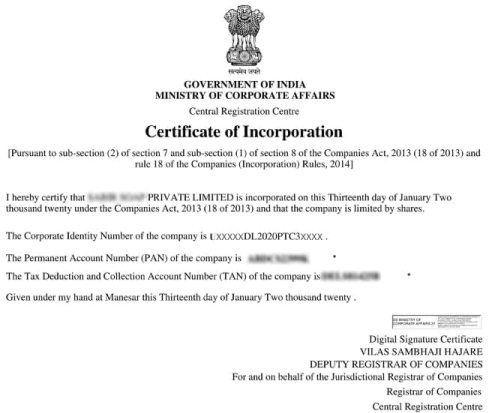
A Company Registration Certificate, also known as the Certificate of Incorporation, is the official proof that your business is legally registered in India. It is issued digitally by the Registrar of Companies after successful company registration in India under the Companies Act, 2013.
This certificate confirms that your business exists as a separate legal entity. It allows the company to open a bank account, enter contracts, apply for licences, and operate lawfully after company incorporation through the MCA portal.

What Information Does the Incorporation Certificate Include?

The Certificate of Incorporation contains essential details that identify your company under MCA registration. These details are used for all future filings, compliance, and official registrations.

  • Approved company name
  • Corporate Identification Number (CIN) issued by the MCA
  • Date of incorporation
  • PAN and TAN allotted at the time of registration
  • Type of company (Private Limited, LLP, OPC, etc.)
  • Registered office address

This certificate serves as the company’s legal identity and is required for ROC registration, banking, taxation, and statutory compliance.

How to Obtain the Certificate of Incorporation

To receive the Certificate of Incorporation, the company must complete the registration process through the MCA portal as part of company registration in India.

  • Submit the SPICe+ application for name approval and incorporation
  • Upload required documents such as MoA, AoA, and identity proofs
  • Provide valid DIN and DSC for all directors
  • Wait for verification by the Registrar of Companies

Once approved, the certificate is issued digitally and can be downloaded from the MCA account after successful company incorporation. No physical copy is issued.

Why the Company Registration Certificate Matters

The Certificate of Incorporation is an essential legal document issued under MCA registration. It confirms that the company is officially recognised and authorised to operate in India.

  • Required to open a current bank account in the company’s name
  • Needed to apply for GST, MSME, FSSAI, and other registrations
  • Acts as proof when raising funds or dealing with investors
  • Enables the company to enter contracts and government tenders
  • Used for ongoing compliance and ROC registration filings

This certificate forms the legal foundation of the company’s existence and operations.
Who Should File ITR

Why Choose TaxCaller for Company Registration in India

Choosing the right partner for company registration in India makes a big difference. TaxCaller focuses on making the registration process simple, accurate, and stress free for entrepreneurs, startups, and growing businesses.

  • Expert guidance on business structure selection
  • Complete company registration online support
  • Accurate documentation and MCA compliant filings
  • Transparent pricing with no hidden costs
  • Dedicated assistance until incorporation is completed

Company Registration Available in Your City

Important Information to Related to Company Registration

Frequently Asked Questions

Company registration in India is the legal process of forming a business under the Companies Act, 2013. Once registered with the Ministry of Corporate Affairs, the business gets a separate legal identity and can operate lawfully.

Yes, company registration online can be completed through the MCA portal. The entire process, including name approval and incorporation, is done digitally using DSC and DIN.

Most startups prefer private limited company registration because it offers limited liability, better credibility, and easier access to funding from investors and banks.

LLP registration India is suitable for professionals and small businesses that want limited liability with fewer compliance requirements compared to private limited companies.

Common company registration documents include PAN, identity proof, address proof of directors, registered office address proof, DSC, and DIN. Requirements may vary based on company type.

If documents are in order, company registration typically takes 7–10 working days. Timelines may vary depending on name approval and MCA verification.

MCA registration is the official registration of your company with the Ministry of Corporate Affairs. It is mandatory to legally incorporate and operate a company in India.

Yes, every company must have a registered office address in India. This address is used for official communication and must be submitted during incorporation.

DIN (Director Identification Number) identifies directors, while DSC (Digital Signature Certificate) is used to sign online forms. Both are mandatory for company incorporation.

After registration, companies must open a bank account, appoint an auditor, and complete ROC registration filings such as annual returns and financial statements.
Most Popular Nationwide Company Registration

Company Registration in India — Start Your Business the Right Way

Trusted nationwide company registration services for startups, founders, and growing businesses across India

Company registration is the first legal step to start a recognised business in India. Whether you are launching a startup or formalising an existing business, registering your company provides legal identity, credibility, and compliance under Indian corporate laws.

At TaxCaller, we provide pan-India company registration services with expert handling of documentation, name approval, incorporation filing, and certificate issuance. Our process is fully online, transparent, and compliant with the latest MCA regulations.

We assist in registration of Private Limited Companies, Limited Liability Partnerships (LLP), One Person Companies (OPC), and Partnership Firms. Our experts guide you in choosing the right business structure based on ownership, taxation, compliance, and future growth.

Company incorporation experts • 100% online process • MCA-approved filing • Complete compliance support

Talk to TaxCaller Expert